
The Honest Answer Most Installers Won’t Give You
“Are solar panels worth it?” is the wrong question. The right question is: worth it for whom, on what roof, with what usage?
Every ad says “solar saves you £1,500/year!” Every forum post says “don’t bother, the payback is 20 years.” Both are lying — or rather, both are right for different homes. The honest answer is that solar is worth it for roughly 65% of UK homes and a bad financial decision for the other 35%.
This guide shows you which group you’re in. We use 2026 data from MCS, Ofgem, DESNZ, and Energy Saving Trust to calculate real returns. No generic averages. No sales pitch. Engineering-led analysis.
💡 At AORO, we turn down roughly 1 in 5 enquiries. Not because we don’t want the business — but because the numbers don’t work for those specific homes. This guide exists to save you the site visit if you’re in that group.
Quick Answer: Are Solar Panels Worth It in the UK?
Yes, for most UK homes with suitable roofs. At current 2026 electricity prices (24.67p/kWh Ofgem price cap Q2), a standard 4kW solar system pays back in 8–12 years and delivers £15,000–£22,000 net profit over its 25-year lifespan.
No, if you fall into one of three specific scenarios:
- Planning to move within 7 years
- North-facing or heavily shaded roof (>30% shade)
- Very low electricity usage (under £60/month)
The rest of this guide explains exactly where you fit.
Solar is not an environmental decision. It’s a financial one.
The carbon reduction is a bonus. The £22,000 net profit over 25 years is the reason.
🎯 Want to know if solar makes sense for YOUR specific home? Book a free 15-minute assessment with AORO — we’ll run the actual numbers for your roof, postcode, and usage. If solar isn’t right for you, we’ll tell you straight. We don’t sell solar to everyone — only where the numbers work.
The Real 2026 ROI: What You Actually Earn
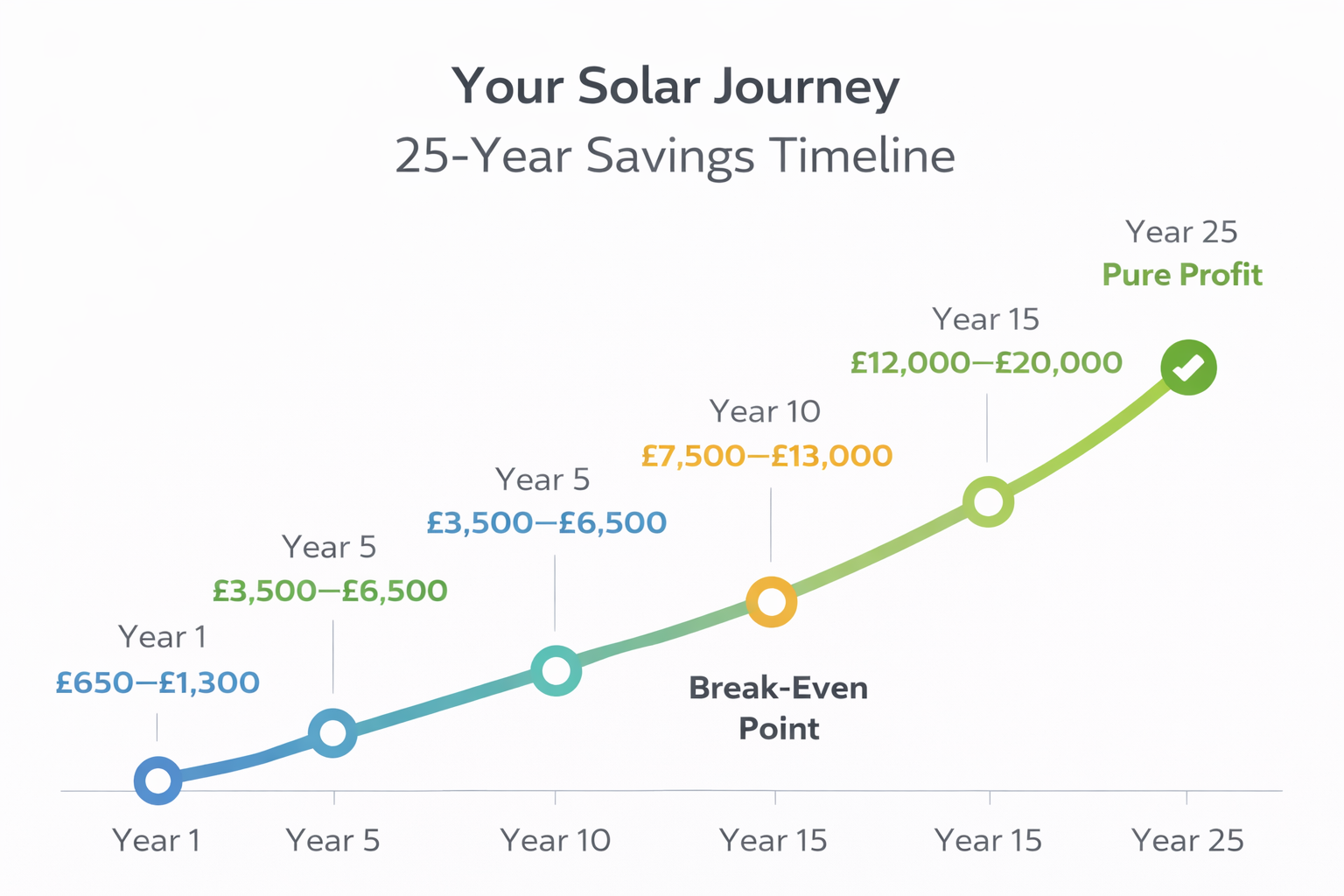
Forget industry averages. Here’s what a real 4kW system delivers in 2026, based on Federation of Master Builders data cross-referenced with Ofgem price cap figures:
Sources: FMB solar calculator (April 2026), Sunsave ROI analysis (March 2026), Ofgem Q2 2026 price cap
The critical variable most installers won’t explain: self-consumption rate. A home using 70% of generated electricity (instead of exporting it at 12p SEG) saves nearly double what a home using 30% saves.
Across every AORO assessment we run, this is the single biggest factor people get wrong in their own maths — they calculate savings as if they’ll use 100% of generation. Reality for most homes without a battery is 35–50%.
Compared to Other Investments: Solar vs Cash ISA vs Property Upgrades
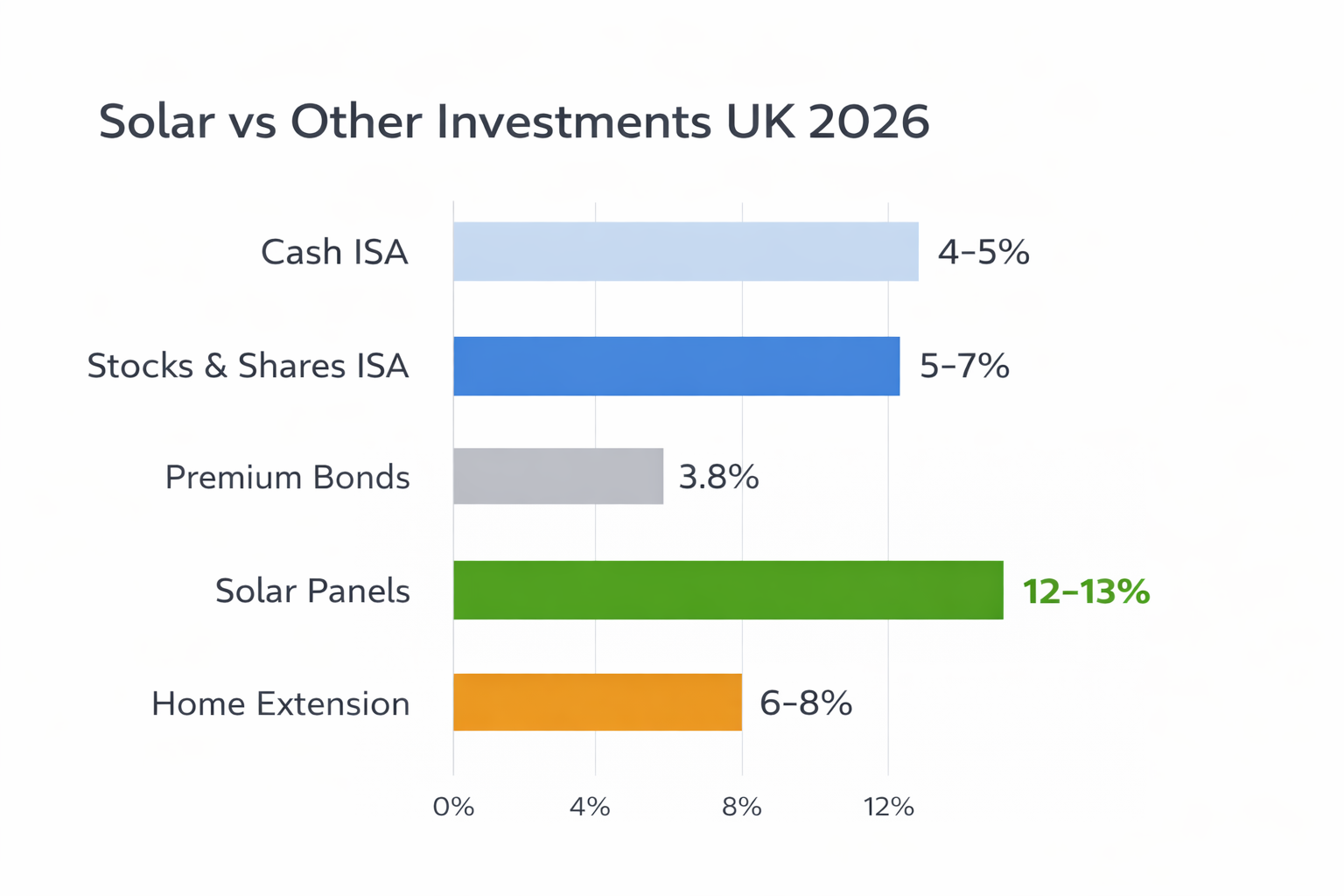
This is where solar’s financial case gets interesting. Current returns compared:
Why solar beats most alternatives: Returns are tax-free (no tax on self-consumed electricity, no tax on SEG income under £1,000/year through trading allowance), inflation-hedged (rising electricity prices = better returns), and guaranteed (the sun will keep rising regardless of market conditions).
The catch: Zero liquidity. You can’t pull capital out. A £6,500 solar investment is locked to your property.
Solar isn’t an investment you exit. It’s an investment you live in.
That’s why the 65% vs 35% question matters more than the 12% return.
When Solar Is Absolutely Worth It (The 65% Scenario)
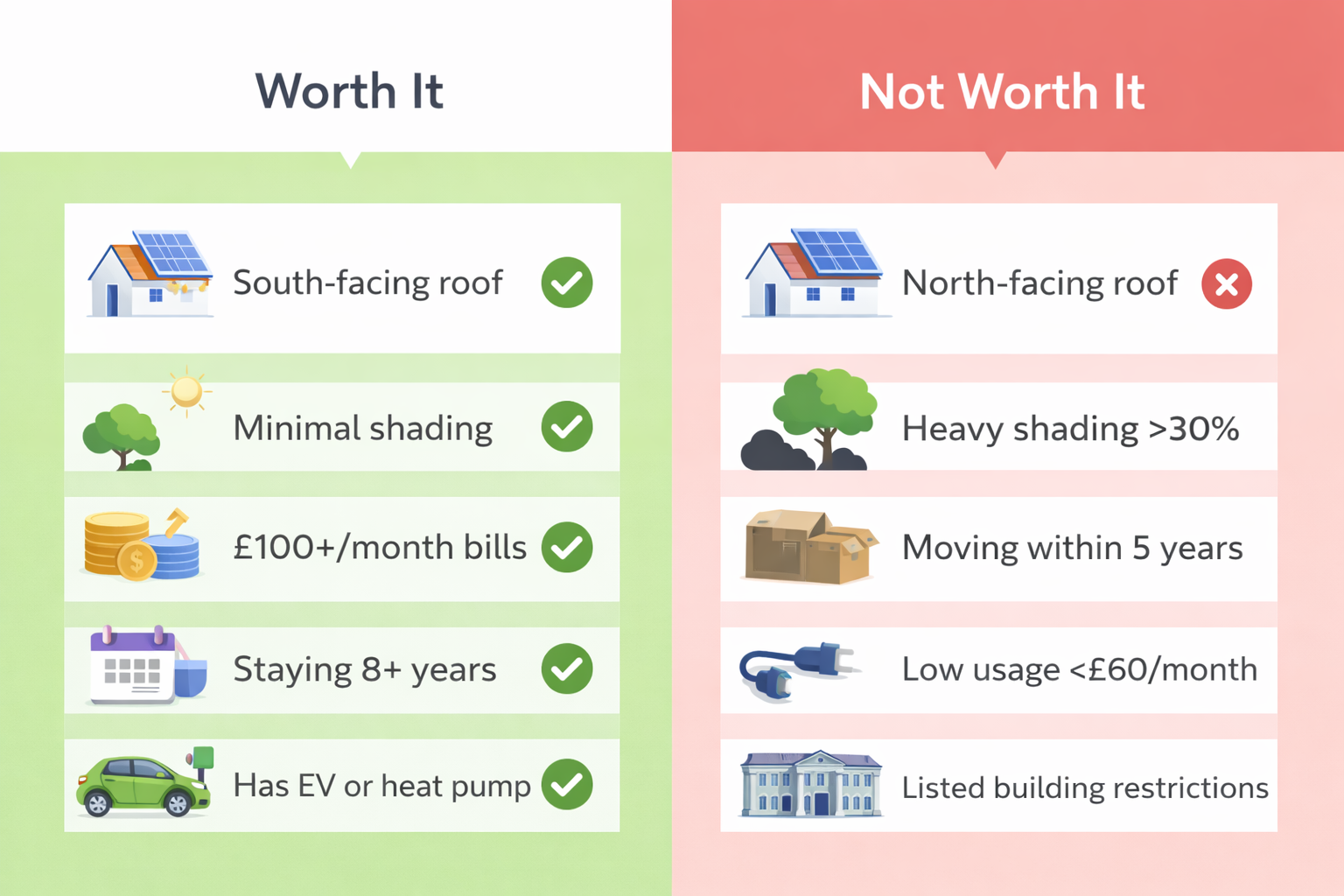
You’re in the “solar pays off big” category if:
✅ Your roof faces south, south-east, or south-west
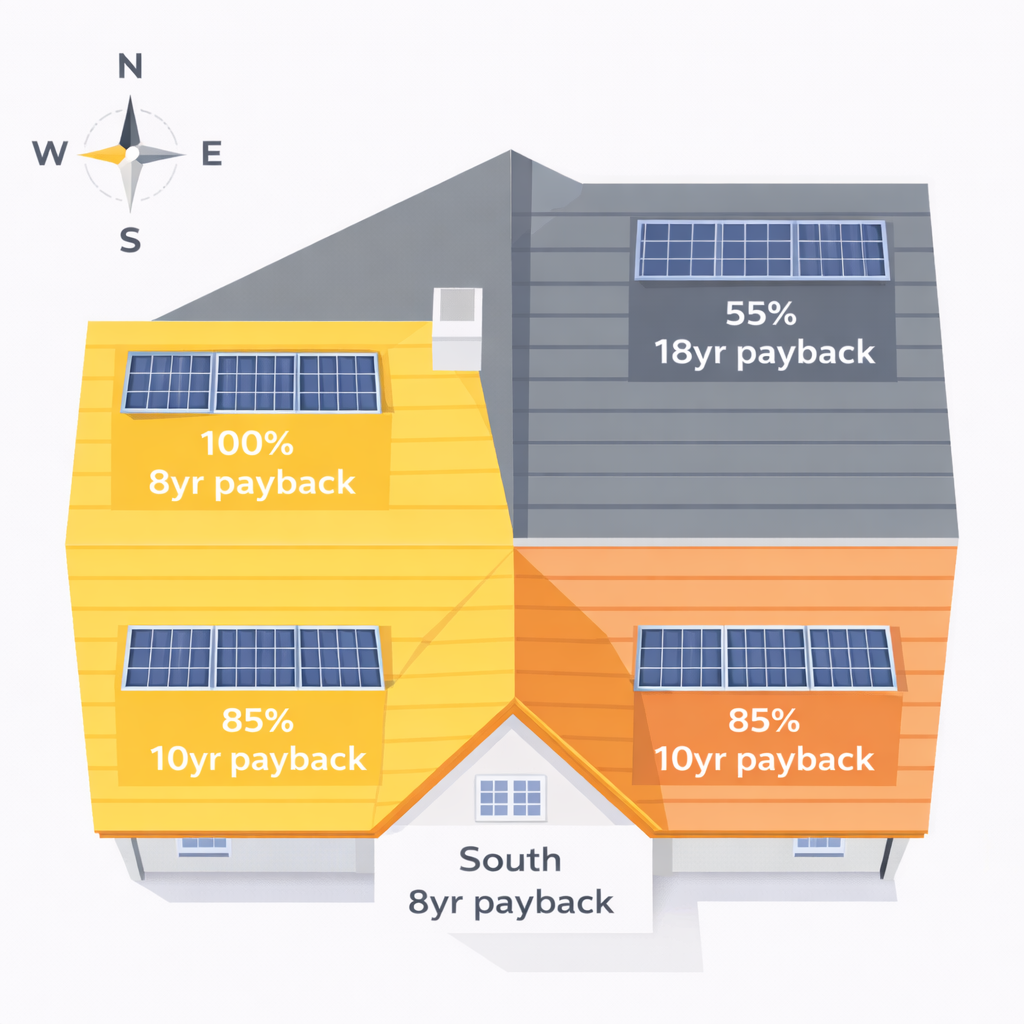
- South: 100% of optimal generation
- South-east/south-west: 95% of optimal
- East or west: 80–85% of optimal (still worthwhile)
✅ Minimal shading (less than 20% of roof shaded during 10am–4pm)
Shading from chimneys, trees, or neighbouring buildings during peak generation hours destroys returns faster than any other factor. Under 20% shade is manageable with DC optimisers; over 30% is usually a dealbreaker.
This is where AORO’s assessment differs from most installers. A standard sales visit checks if panels fit. Our shading analysis uses satellite data and hour-by-hour sun path modelling — because a 45-minute site visit can’t catch tree shade that only hits your roof in September afternoons.
✅ You use £100+/month in electricity
Higher usage = more self-consumption = faster payback. Homes consuming 3,500+ kWh annually see the shortest payback periods.
✅ You’ll stay in the property 8+ years
Solar doesn’t add £1-for-£1 to property value. A £7,000 system typically adds £4,000–£7,000 to resale value. If you’re selling in under 8 years, you may not fully recover your investment.
✅ You have an EV or heat pump (or planning one)
This is where solar becomes a financial no-brainer. Every kWh powering your EV instead of grid electricity saves 25p. An EV using solar daily can save an additional £400–£800/year on top of standard household savings.
When Solar Is NOT Worth It (The 35% Scenario)
Honest assessment: skip solar if any of these apply to you.
❌ North-facing roof (no south alternative)
North-facing panels generate 40–50% less electricity than south-facing, according to Sunsave orientation analysis. Payback extends to 18–22 years on a north-only installation. Exception: if you already have south-facing panels and want to “fill up” remaining roof space, north-facing adds incremental value (the fixed scaffolding and labour costs are already paid).
❌ Heavy shading (>30% of roof)
Trees, tall buildings, or chimneys blocking sun for significant portions of the day reduce generation by 30–70%. Power optimisers help with partial shading, but severe shading makes solar uneconomical.
❌ Planning to move within 5–7 years
You need 8–12 years to break even. If you’re moving sooner, the value added to your property (£4,000–£7,000) typically won’t recover your full installation cost.
❌ Very low electricity usage
If your monthly bill is consistently under £60 (roughly 2,000 kWh/year), the savings pool is too shallow. A 2 kW system costs nearly as much to install as a 4 kW (fixed scaffolding, labour, certification), but saves far less.
❌ Listed building or conservation area restrictions
Heritage restrictions can block installation or force expensive compliance requirements. Check with your local planning authority before committing.
At AORO, we say “no” to about 1 in 5 enquiries.
The sales industry calls that leaving money on the table. We call it protecting our reputation.
⚡ Not sure which category you fall into? The honest truth is you can’t know without a proper site assessment. Get a free evaluation from AORO — we’ll tell you honestly if it’s worth it, or save you £7,000 by saying no.
The Hidden Financial Benefits Most Guides Skip
Beyond the direct electricity savings, solar creates financial value in ways salesmen don’t always mention (because they’re harder to quantify):
1. Property Value Boost
A study by Solar Energy UK (2025) found solar adds an average of £7,000–£10,000 to UK property valuations. This varies regionally — London and the South East see the strongest uplift. An EPC rating improvement from D to C (common with solar) can increase property value by 3–5%.
2. Green Mortgage Discounts
Several UK lenders now offer discounted rates for energy-efficient homes. Barclays Green Home Mortgage offers 0.1–0.2% rate reductions. On a £200,000 mortgage, that’s £400/year in savings — £10,000 over a 25-year term.
3. Protection Against Rising Energy Prices
Between 2021 and 2025, UK electricity prices rose 58%. Solar locks in your generation cost at today’s rates for 25 years. Every 10% electricity price rise increases your solar ROI by approximately 15%.
4. Buy-to-Let Rental Advantage
Landlords with solar-equipped properties can command 5–8% higher rents in markets where energy efficiency matters. Post-2025 EPC regulations require rental properties to hit minimum C-rating — solar often pushes properties over the threshold.
5. SEG Trading Arbitrage (For Battery Owners)
With Octopus Flux or similar time-of-use tariffs, battery owners can buy cheap overnight electricity (at 7–8p/kWh) and export peak daytime solar (at 15–25p/kWh). This arbitrage adds £150–£250/year on top of standard solar savings.
The electricity savings are the headline. The 5 hidden benefits above are where the real money lives.
Most homeowners never hear about these because salesmen don’t get commission on “£10,000 mortgage savings over 25 years.”
Realistic Timeline: What to Expect Year by Year
Here’s what actually happens after installation, based on real UK user data and installations we’ve tracked:
Year 10 inverter replacement is the one expense people forget. In every AORO quote, we explicitly line-item this — because the industry standard of “hiding” this cost leads to nasty surprises a decade later.
Battery Storage: Worth It or Not?
The honest answer: it depends on your lifestyle, not on generic advice.
Battery makes sense if:
- You’re home during the evening (primary peak usage 5–9pm)
- You have variable/time-of-use tariff (Octopus Flux, Agile)
- You have an EV that charges overnight
- You value energy independence during grid outages
Battery doesn’t make sense if:
- You work from home during daylight hours (you’re already self-consuming)
- You’re on a fixed tariff with no time-of-use differential
- Your primary solar goal is export income (Octopus Outgoing at 12p/kWh)
The maths: A 5 kWh battery costs £3,000–£4,500 and saves roughly £290/year. Standalone battery payback is 10–15 years. Combined with solar, it shortens overall payback by 1–2 years in most scenarios but extends break-even by 2–4 years.
Our typical AORO recommendation: start with solar-only, add battery in year 2–3 when you understand your actual consumption patterns. That’s the opposite of what most installers push (they want to sell the battery upfront because margins are higher).
Most installers push batteries because margins are higher, not because they’re right for you.
The honest answer: roughly 40% of our clients don’t need one. Those who do benefit massively. Find out which group you’re in before you commit.
🔋 Torn on whether to add a battery? Don’t guess. Get an AORO assessment — we’ll model your actual usage patterns and tell you if a battery earns its keep. Sometimes “no” is the right answer.
What Does This Cost Per Month?
The £6,500–£12,000 upfront figure feels heavy. Here’s what it actually looks like financed:
The reframing: Your current electricity bill averages £137/month at Q2 2026 Ofgem price cap levels. A 4 kW system financed over 10 years at roughly £70/month, combined with £55–£70/month in electricity savings, often produces net monthly cost close to zero — while you own a £6,500+ asset at the end of year 10.
After the loan ends, the system keeps generating at pure profit for another 15+ years.
The 244,000 UK Homeowners Can’t Be Wrong (Or Can They?)
In 2025, a record 244,000 UK households installed solar — the highest annual figure in history. The numbers keep accelerating in 2026.
Why the rush?
- 0% VAT ending March 2027 — creates urgency
- Electricity prices 58% higher than 2021 — solar maths improved dramatically
- Panel costs dropped 30% since 2020 — installations never cheaper
- Improved battery economics — time-of-use tariffs reward storage
- Property value boost — important for landlords facing EPC regulation
244,000 homeowners said yes. But that includes the 85,000 who shouldn’t have.
Mass adoption isn’t a signal. Your specific roof, usage, and timeline are.
Don’t install solar because your neighbour did. Install solar because the numbers work for your specific property.
Red Flags: When “It’s Worth It!” Is a Sales Pitch
Based on Trading Standards complaints data (2024–2026), these are the most common misleading claims:
- ❌ “Payback in 5 years!” — Possible only with unrealistic self-consumption assumptions or post-2022 energy price scenarios
- ❌ “Free solar panels” — The rent-a-roof schemes ended in 2019 when FiT closed. Anyone offering “free solar” now is financing it at terrible rates
- ❌ “Solar adds £15,000 to property value” — Average uplift is £4,000–£7,000, not £15,000
- ❌ “You’ll never pay another electricity bill” — Solar typically covers 50–70% of annual demand, not 100%
- ❌ “Act today — prices rising tomorrow” — Legitimate MCS installers hold quotes for 30–90 days
- ❌ “Our panels last 50 years” — Tier-1 panels warranty at 25 years, realistic lifespan 30–35 years
Any installer using these lines is either misinformed or counting on you not doing the maths.
Questions to Ask Before Saying Yes
Before you commit to installation with any installer, demand these answers in writing:
- What is my specific property’s expected annual generation (kWh) based on roof orientation, pitch, and local weather data?
- What self-consumption rate have you assumed for the savings calculation? (If they say 70%+, ask how you’ll achieve that)
- What happens at year 10–12 when the inverter needs replacement? Who pays?
- What warranty backs the savings projections? (Spoiler: none legally can — but their MCS insurance should cover workmanship)
- If I sell my house in 5 years, what happens to finance agreements or SEG registration?
- Have you run a shading analysis with actual software (e.g. PV*SOL, PVSyst)?
- Is the insurance-backed warranty underwritten by IWA, QANW, or HIES?
At AORO, every quote answers all seven in writing by default. If your current installer can’t, that’s your answer about whether it’s worth it with them.
Why AORO Is Different
Most installers work on commission. We don’t. That changes everything about how we operate.
What this means for you:
- We turn down ~1 in 5 enquiries where the numbers don’t work. No commission pressure to push bad fits.
- Our quotes are itemised — every component visible, no bundled mystery
- Shading analysis uses proper software (PV*SOL with real weather data), not “eyeball from the van”
- Year 10 inverter replacement is line-itemed in every quote, not hidden
- Battery recommendations honest — if you don’t need one, we’ll say so
- MCS certification means automatic SEG registration support
- Insurance-backed warranty — protected even if we disappeared tomorrow
We’d rather do 100 installations for the right homes than 300 for anyone who’ll sign.
Get Your Exact ROI Numbers (For Your Specific Home)
Generic answers won’t tell you if solar is worth it. Your answer depends on your roof, your postcode, your usage, your plans.
In a free 15-minute assessment, AORO delivers:
- ✅ Precise payback period for YOUR home (not UK averages)
- ✅ 25-year ROI projection based on your actual electricity usage
- ✅ Honest verdict — including “don’t do it” when that’s the right call
- ✅ System sizing recommendation (3kW vs 4kW vs 6kW)
- ✅ Battery recommendation (yes, no, or “wait”)
- ✅ Financing options with exact monthly figures
- ✅ Written quote that answers all 7 critical questions above
Typical response time: same working day. We limit bookings to 6/week to ensure every assessment gets proper attention. No sales pressure. No follow-up spam. No commission-driven nonsense.
We don’t sell solar to everyone. Only where the numbers work.
Frequently Asked Questions
Are solar panels worth it in the UK in 2026?
Yes, for approximately 65% of UK homes — specifically those with south/south-east/south-west facing roofs, minimal shading, electricity bills over £100/month, and plans to stay in the property 8+ years. Solar is not worth it for north-facing roofs, heavily shaded properties, very low usage homes, or homeowners moving within 5 years.
How long do solar panels take to pay for themselves in the UK?
A standard 4 kW solar system pays back in 8–12 years at 2026 electricity prices. Systems with battery storage take 10–14 years. Homes with EVs or heat pumps see faster payback (7–10 years) due to higher self-consumption.
Do solar panels increase UK property value?
Yes, by approximately £4,000–£7,000 for a standard installation, according to Solar Energy UK (2025). The uplift is strongest when solar pushes the property’s EPC rating from D to C. London and the South East see the strongest value increases.
Are solar panels worth it without a battery?
Yes, for homes where occupants are present during daylight hours (10am–4pm). Without a battery, you’ll self-consume 35–50% of generated electricity and export the rest at SEG rates (7.9–12p/kWh). Solar-only systems have the shortest absolute payback periods.
Will my solar panels work on cloudy UK days?
Yes. Modern panels generate 10–25% of peak output on overcast days and still produce meaningful electricity. UK solar systems typically operate year-round, with winter generation at 20–30% of summer levels. Annual output is what matters, not daily variation.
What if I move house after installing solar?
Solar systems stay with the property — they add value to the sale price (£4,000–£7,000 average) but cannot be relocated. If you’re selling within 5 years, you may not recover the full installation cost. If staying 8+ years, the investment is typically profitable regardless of whether you eventually sell.
Does roof orientation really matter that much?
Yes. South-facing roofs generate 100% of optimal output. South-east/south-west: 95%. East or west: 80–85%. North-facing: only 50–60%. Roof orientation directly affects payback period — south roofs achieve 8-year payback while east/west extends to 10–11 years.
Sources & Data
- Ofgem price cap announcements (Q2 2026)
- Federation of Master Builders solar ROI calculator (April 2026)
- Microgeneration Certification Scheme installation data (2026)
- Solar Energy UK property value study (2025)
- Energy Saving Trust solar calculator (2026)
- Sunsave Octopus export tariff analysis (March 2026)
- DIY Solar UK 2026 ROI breakdown (March 2026)
- Greenmatch UK solar savings report (2026)
- Heatable independent solar analysis (March 2026)
AORO is an MCS-certified solar installer. Accreditation details and insurance-backed warranty information available on our accreditations page. This article reflects market data as of April 2026 and is updated quarterly as Ofgem price caps and SEG rates change.

Comments are closed