
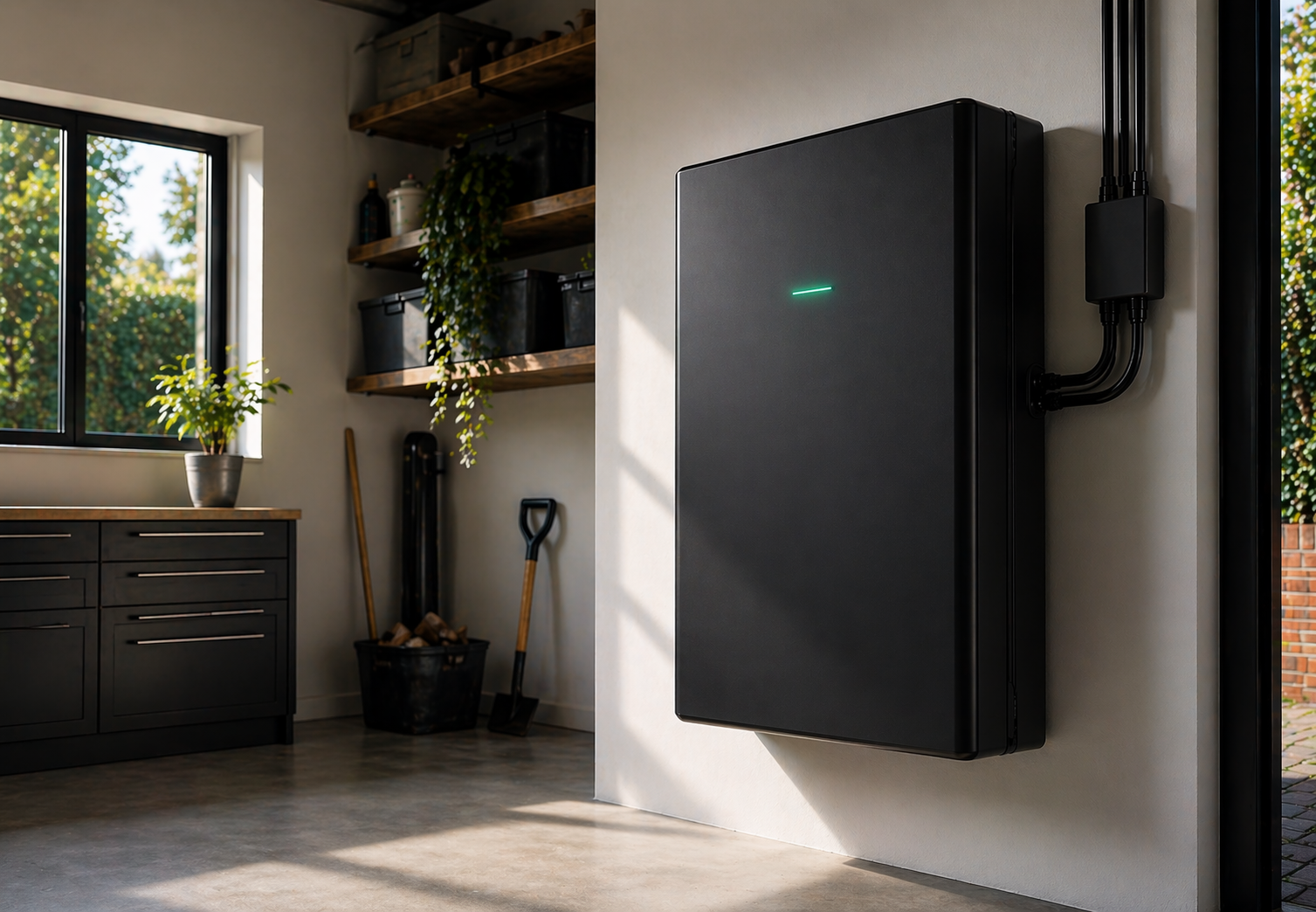
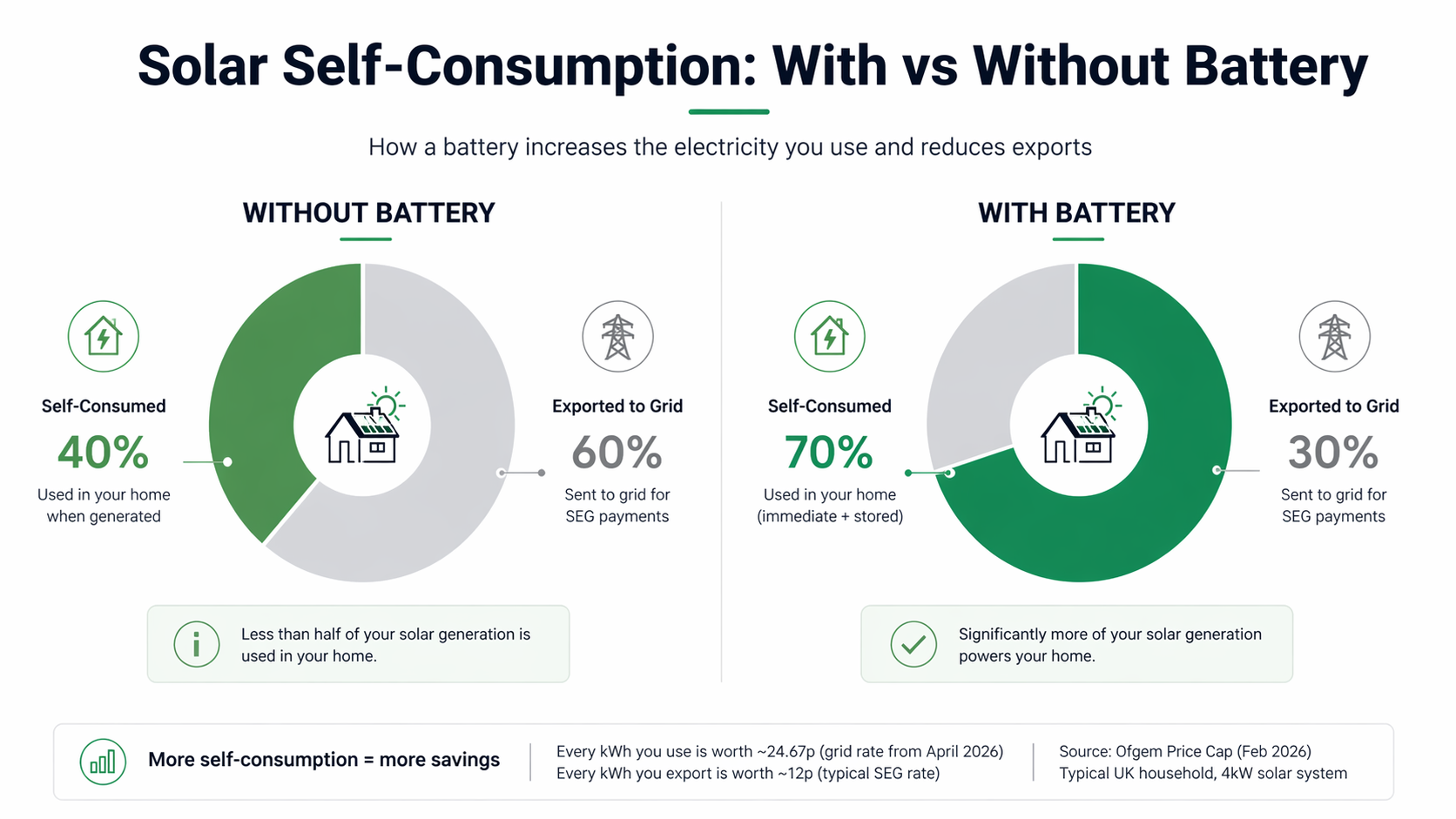
A solar battery adds £3,000–£5,000 to your solar installation cost. It pushes self-consumption from 35–50% up to 60–80%. The real question isn’t whether batteries work — they do — it’s whether that additional capital delivers a return that justifies it.
This guide gives you an honest answer. We use February 2026 pricing data from MCS-certified installers, current Ofgem tariffs, and typical UK household consumption figures to show when a battery earns its keep — and when the same £4,000 sits better in a Cash ISA.
A short version for people who want it straight: batteries make strong financial sense for some UK homes. For others, they’re a lifestyle purchase wearing an investment disguise. The difference depends on four specific factors — all covered below.
Quick Answer: Is a Solar Battery Worth It in 2026?
Yes, for roughly 55% of UK solar homes. A battery typically adds £290–£450/year to your savings, reducing your payback on the full solar-plus-battery system by 1–2 years compared to solar alone — provided you’re on a time-of-use tariff and home-heavy in the evenings.
No, for the other 45%. If you work from home during daylight hours, pay a flat-rate tariff, or already self-consume 50%+ of your generation, a battery’s standalone payback stretches to 15–22 years — longer than most warranties.
The rest of this guide walks you through exactly where you fit.
What a Solar Battery Actually Does (The Honest Version)
A solar battery stores daytime generation for use later. That’s the mechanical function. The financial function is slightly different — and more important.
When your panels generate electricity, you have three options for each kWh:
- Use it now (save the grid rate: 24.67p/kWh from April 2026)
- Store it for later (use instead of importing — same 24.67p/kWh saved)
- Export it (earn the SEG rate: typically 12p/kWh on Octopus Outgoing)
The arithmetic is straightforward. Every kWh you shift from “export” to “store and use” is worth roughly 12.67p extra (the gap between retail import and SEG export). Over a year, a 5kWh battery cycling daily captures about 1,500–1,800 kWh of this arbitrage — £190–£230 in direct savings.
Add a time-of-use tariff like Octopus Flux, where you can charge cheaply overnight (7–8p/kWh) and export at peak rates (15–25p/kWh), and that figure climbs to £290–£450/year. The battery stops being just a storage device and becomes a trading asset.
A battery isn’t storage. It’s arbitrage.
The economic value isn’t in keeping electrons — it’s in shifting them between cheap periods and expensive ones.
What a Solar Battery Actually Costs in 2026
UK battery prices vary significantly by capacity, chemistry, and whether it’s installed alongside a new solar system or retrofitted. Retrofits typically cost £500–£1,000 more because of additional labour and potential inverter upgrades.
Sources: OVO 2026 market data, EE Renewables battery pricing, MCS installer benchmarks
A note on chemistry: LFP (Lithium Iron Phosphate) has become the default for UK residential installations because of its safety profile, 10–15 year warranty, and stable performance. Lead-acid remains cheapest upfront but requires replacement every 5–7 years — more expensive over the long run. We no longer recommend lead-acid to residential customers.
The Real Savings: Three Scenarios
Battery economics depend heavily on your tariff strategy. These three scenarios show the realistic range:
Scenario A: Fixed Flat-Rate Tariff, Daytime Usage
You’re home during the day, already self-consuming 50%+ of generation. A battery pushes self-consumption to perhaps 70%.
- Additional self-consumption: 20% of 3,600 kWh = 720 kWh
- Value gained: 720 × 12.67p (retail–SEG gap) = £91/year
- 5kWh battery at £3,000: 33-year standalone payback
Verdict: Don’t bother. You’re already capturing most of the value without one.
Scenario B: Flat-Rate Tariff, Evening-Heavy Household
Working family, out during the day, peak usage 5–9pm. Without a battery, you self-consume maybe 30% and export the rest at 12p while importing at 24.67p in the evening.
- Additional self-consumption with battery: 40% of 3,600 kWh = 1,440 kWh
- Value gained: 1,440 × 12.67p = £182/year
- 5kWh battery at £3,000: 16-year standalone payback
Verdict: Marginal. Worth it if you’re planning to stay 20+ years, otherwise borderline.
Scenario C: Time-of-Use Tariff (Octopus Flux or Similar)
This is where batteries transform from marginal to compelling. You charge cheaply overnight at 7–8p/kWh, export during peak-demand windows at 15–25p/kWh, and use stored solar in the evening.
- Self-consumption value: £180/year
- Time-of-use arbitrage: £150–£250/year
- Total annual benefit: £330–£430/year
- 5kWh battery at £3,000: 7–9 year standalone payback
Verdict: Genuinely worth it. Payback comfortably inside warranty period with margin for future tariff changes.
🔋 Not sure which scenario fits your household? Book a free AORO assessment — we’ll model your actual usage pattern and tell you honestly whether a battery earns its keep. Sometimes “not yet” is the right answer.
When a Battery Is Worth It
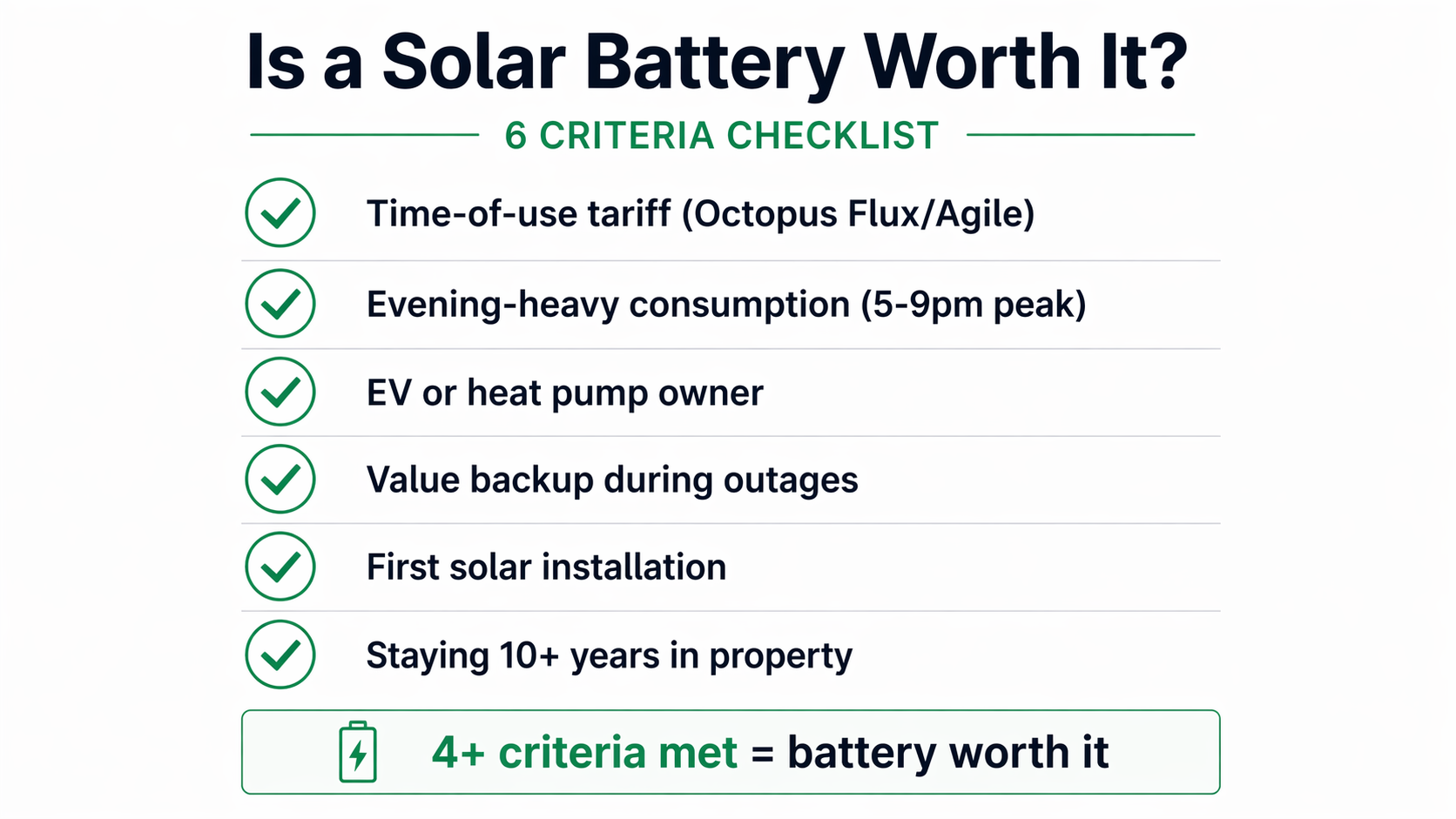
A battery makes financial sense when most of these apply:
- ✅ You’re on (or willing to switch to) a time-of-use tariff. This single factor changes the economics more than anything else.
- ✅ Your peak usage is 5–9pm. Evening-heavy households capture the largest arbitrage window.
- ✅ You have an EV or heat pump (or plan one within 3 years). Both dramatically increase evening consumption, making battery storage essential rather than optional.
- ✅ You value grid independence during outages. A battery with backup capability keeps essentials running. This isn’t a financial metric, but it’s a real benefit.
- ✅ You’re installing solar for the first time. Adding a battery during the original install saves £500–£1,000 vs retrofitting later.
- ✅ You plan to stay in the property 10+ years. Short-stay homeowners rarely recover the battery cost through resale value alone.
If four or more apply, a battery is almost certainly worth it. Two or fewer? Skip it, at least for now.
When a Battery Isn’t Worth It
Being honest about this matters more than the rest. Here’s when we tell customers to skip the battery:
- ❌ You work from home during daylight hours. You’re already self-consuming 50–60% of generation. Adding a battery gives you maybe 15% more — not enough to justify £3,000–£5,000.
- ❌ You’re locked into a flat-rate tariff. Without time-of-use pricing, you lose the arbitrage opportunity that makes batteries genuinely profitable.
- ❌ Your primary solar goal is export income. Tariffs like Octopus Outgoing at 12p/kWh make exporting competitive with self-consumption in many scenarios.
- ❌ Your electricity usage is under 2,500 kWh/year. The savings pool is too small to justify the capital.
- ❌ You’re planning to move within 5 years. Batteries add £2,000–£4,000 to resale value on average — not the £3,000–£5,000 you spent.
In these cases, our standard recommendation is start with solar-only, add a battery in year 2–3 once you understand your actual consumption patterns. Retrofitting costs slightly more, but you avoid committing capital to a device that may not earn its keep.
What Size Battery Do You Actually Need?
Oversizing is the most common battery mistake we see. The marginal value of each additional kWh drops quickly once you pass your evening consumption needs.
The Sizing Formula (Simplified)
Calculate your typical evening consumption (6pm–10pm). That’s your target capacity. For most UK households:
- Small household (1–2 people): 5 kWh covers most evenings
- Typical family (3–4 people): 8–10 kWh is the sweet spot
- Large household with EV/heat pump: 13–15 kWh
- Off-grid aspirations: 20+ kWh, but the financial case weakens significantly
A 20 kWh battery on a home using 8 kWh in the evening sits half-idle most nights. The unused capacity adds cost without adding savings. An installer proposing a much larger battery than your consumption supports is either misreading your needs or optimising for commission.
Worked Example: Solar-Only vs Solar-Plus-Battery
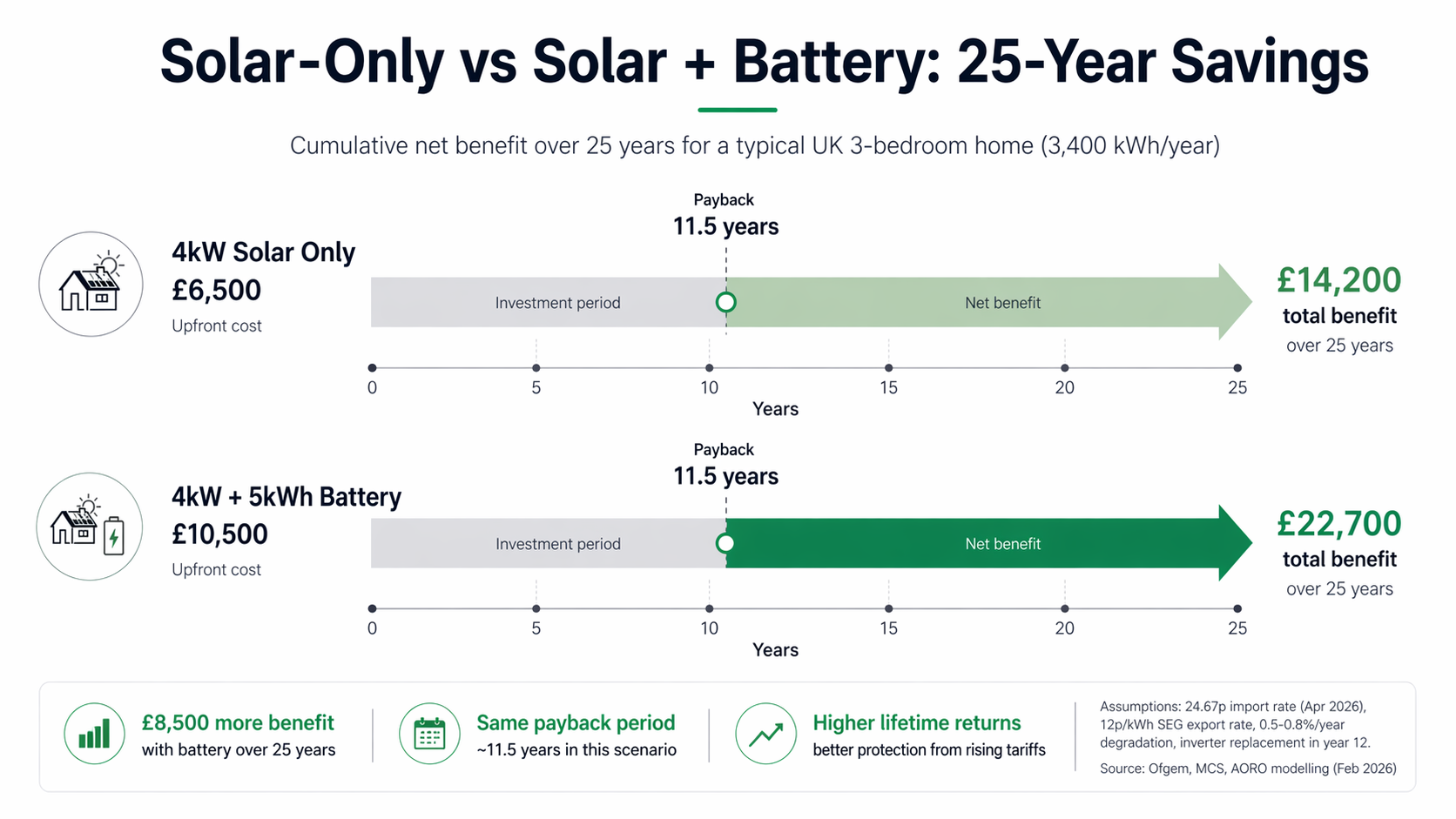
Consider a 3-bed semi in the South East, using 3,400 kWh/year, family home during evenings, on Octopus Flux:
The counterintuitive result: in the right scenario, adding a battery doesn’t slow your payback — it increases annual savings proportionally enough to match the payback timeline while delivering a higher long-term return. Over 25 years, the battery system delivers an additional £8,000–£10,000 in net benefit.
Actual payback is sensitive to future electricity prices, SEG tariff changes, and panel/battery degradation (both decline roughly 0.5–1% per year). Rising grid prices shorten payback; falling prices extend it. Budget for one battery replacement at year 12–15 if you expect the system to run its full 25-year course.
Three Mistakes People Make with Solar Batteries
Mistake 1: Buying a Battery Without Changing Tariff
The time-of-use tariff is 70% of the battery’s value proposition. Buying a £4,000 battery while staying on a flat-rate tariff is like buying a sports car and driving it only in school zones. Switch first, then install.
Mistake 2: Oversizing “Just in Case”
A 15 kWh battery on a 4 kW solar system rarely fills more than 60% on a typical UK day. You’ve spent £3,000 extra on capacity that sits unused. Match battery size to actual evening consumption, not to marketing brochures.
Mistake 3: Assuming Backup Power Works Automatically
Not all batteries provide blackout backup — and those that do usually require a specific inverter configuration (Gateway or Backup Module) that costs £500–£1,500 extra. If grid independence during outages matters to you, specify this requirement explicitly in your quote.
Get a Battery Recommendation That’s Right for Your Home
Generic advice doesn’t help. What matters is your usage pattern, tariff, and consumption profile.
In a free 15-minute assessment, AORO delivers:
- ✅ Usage pattern analysis — when you actually consume electricity
- ✅ Battery sizing recommendation — exact kWh capacity, not oversold
- ✅ Tariff optimisation advice — which supplier pairs best with battery
- ✅ Realistic payback projection for your specific scenario
- ✅ Honest recommendation — including “skip the battery” when that’s right
- ✅ Line-itemised quote — no bundled mystery charges
Typical response time: same working day. Limited to six assessments per week. No sales pressure. No follow-up spam.
We don’t sell batteries to everyone. Only where the numbers work.
Frequently Asked Questions
Is a solar battery worth the extra £3,000–£5,000 in the UK?
For approximately 55% of UK solar homes, yes. A battery adds £290–£450/year in savings when paired with a time-of-use tariff. For homes on flat-rate tariffs or with daytime occupancy already self-consuming 50%+ of generation, the additional capital rarely earns its keep within warranty.
How much does a solar battery cost in the UK in 2026?
A 5 kWh LFP battery costs £2,500–£3,500 installed with new solar. A 10 kWh costs £4,500–£6,500. Retrofitting adds £500–£1,000 to these figures. Premium brands like Tesla Powerwall or Enphase run £7,000–£12,000+ depending on configuration.
How long does a solar battery pay back?
Standalone battery payback ranges from 7 years (time-of-use tariff, evening-heavy household) to 22 years (flat-rate tariff, daytime occupancy). The typical UK home falls in the 10–15 year range. Always check payback against warranty length before committing.
What size solar battery do I need?
Size the battery to your typical evening consumption (6–10pm). Most UK households need 5–10 kWh. EV owners or heat pump households benefit from 10–15 kWh. Oversizing beyond this range rarely improves returns and often sits underused.
How long do solar batteries last?
Modern LFP batteries carry 10–15 year warranties with typical capacity degradation of 1–2% per year. Physical lifespan often reaches 15–20 years. Most households replacing a battery once over a 25-year solar system lifespan.
Do I need a battery to qualify for the Smart Export Guarantee?
No. SEG requires an MCS-certified installation and a smart meter capable of recording half-hourly export. Batteries are optional. In fact, adding a battery reduces SEG income because you export less — you’d instead capture the higher value by self-consuming stored electricity.
Can I add a battery to an existing solar system?
Yes, through a retrofit. Costs run £500–£1,000 higher than combined installation due to additional labour and possible inverter upgrade. AC-coupled batteries make retrofitting easier and work with most existing inverters.
Will a battery keep my lights on during a power cut?
Only if specifically configured for it. Standard grid-tied batteries switch off during outages for safety. Backup capability requires a dedicated module (Tesla Gateway, Enphase Enpower, or equivalent) adding £500–£1,500 to the install. Specify this upfront if blackout protection matters to you.
What’s the best solar battery brand in the UK 2026?
Depends on priorities. Tesla Powerwall leads on software and backup capability but carries a premium price. GivEnergy, Sunsynk, and Puredrive offer strong UK-supported mid-range options. Enphase suits homes with complex shading. The “best” battery is the one that matches your usage pattern, warranty requirements, and budget — not the most-advertised brand.
Is the 0% VAT applied to solar batteries?
Yes. Since February 2024, the 0% VAT relief covers residential battery storage — whether installed alongside solar or retrofitted to an existing system. This relief runs until 31 March 2027, after which 5% VAT returns.
The Bottom Line
Solar batteries in 2026 are neither the “must-have” the marketing suggests nor the “waste of money” some forums claim. They’re a conditional investment — powerful when paired with time-of-use tariffs and evening-heavy consumption, marginal otherwise.
Our honest split: roughly 55% of solar-ready UK homes benefit from a battery today, and that proportion will grow as time-of-use tariffs become more common and battery prices continue falling. For the other 45%, starting with solar-only and adding a battery in year 2–3 is usually the better call.
The right answer for your home depends on four specific things: your tariff, your evening usage, your future plans (EV? heat pump?), and how long you’ll stay in the property. A proper assessment answers all four in 15 minutes.
⚡ Want to know if a battery makes financial sense for your specific home? Get a free solar quote from AORO Solar — MCS-certified, engineering-led, no commission-driven nonsense.

Comments are closed