
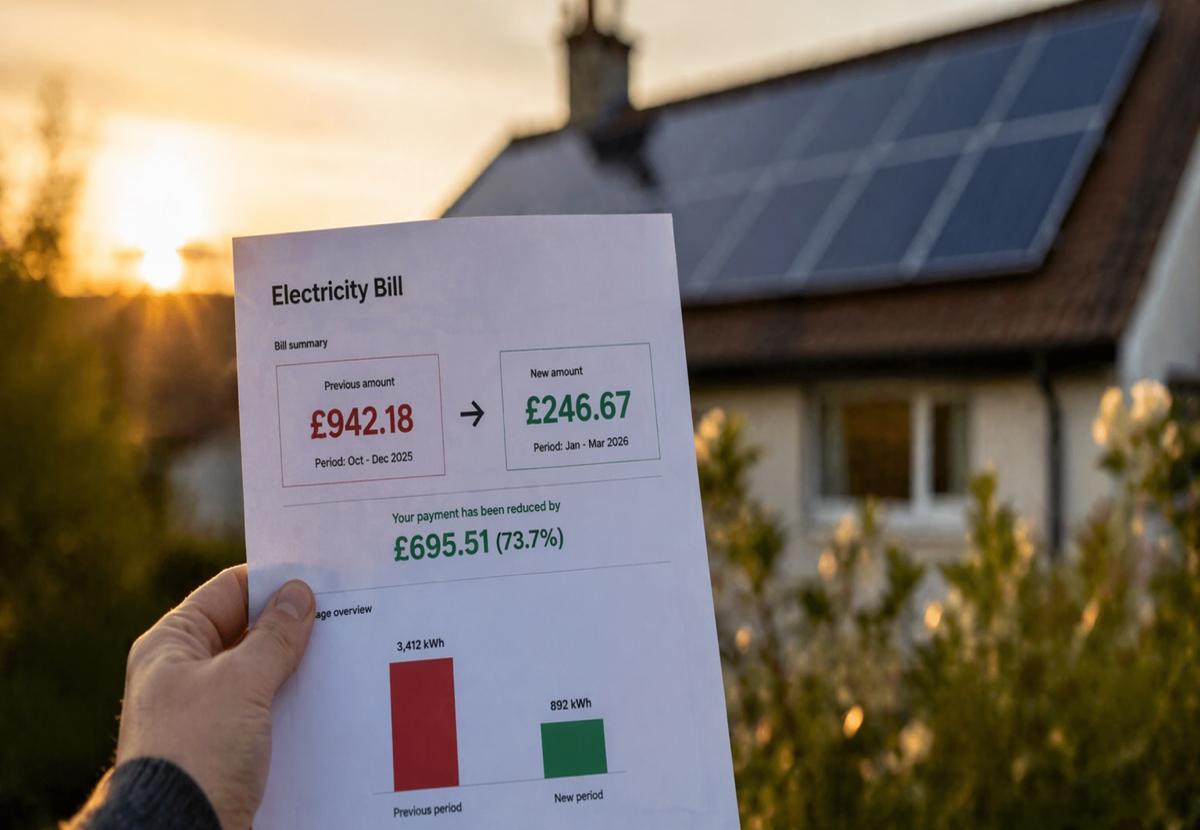
As of February 2026, the average UK dual-fuel household pays £1,758 a year, according to Ofgem’s current price cap. That’s still 44% above pre-2021 levels, with Ofgem’s latest figures confirming bills will ease only slightly from April.
To be precise, solar cuts the electricity portion of your bill, not your gas bill — but for most households that still means the single biggest reduction available.
Most UK homeowners have resigned themselves to this. Smart meters, thermostat tweaks, LED bulbs — small wins, rarely adding up to more than 10–15% savings. Solar works differently. A properly sized system cuts the electricity portion of your bill by 40–70%, depending on your roof, usage patterns, and whether you add battery storage.
One important clarification before we go further: the £1,758 figure covers both electricity and gas combined. Solar panels reduce electricity imports, not gas consumption. The savings figures throughout this guide refer specifically to the electricity portion of your bill — typically £700–£900/year for a standard UK household.
This guide uses the latest available Ofgem figures, MCS installation data, and real UK numbers to show exactly how much solar cuts your bills — and what it costs to get there.
Why UK Energy Bills Remain Painful in 2026
Ofgem has confirmed a 7% reduction to the price cap from April 2026, bringing the typical dual-fuel bill to £1,641. That’s welcome, but the House of Commons Library confirms bills will still sit 44% above winter 2021/22 levels. Three structural factors keep pressure on UK households:
- Gas sets the electricity price. UK electricity pricing follows a “marginal cost” model — the last (most expensive) generator online typically sets the rate, and that’s usually gas. Even as renewables grow, gas continues to dictate the benchmark.
- UK electricity is among Europe’s most expensive. In the first half of 2025, UK domestic electricity was higher than every EU country except Germany.
- Standing charges keep climbing. Even with zero usage, households pay 54.75p per day (£200/year) under the current cap simply to remain connected.
The current cap sets electricity at 27.69p per kWh, falling to 24.67p from April. Every kWh your solar panels produce and you use yourself is a kWh you don’t pay the grid rate for.
You can’t control Ofgem. You can control your roof.
Wholesale gas prices, network costs, and standing charges are outside your hands. A 4kW solar system on your own roof isn’t.
How Much Solar Actually Cuts Your Electricity Bill
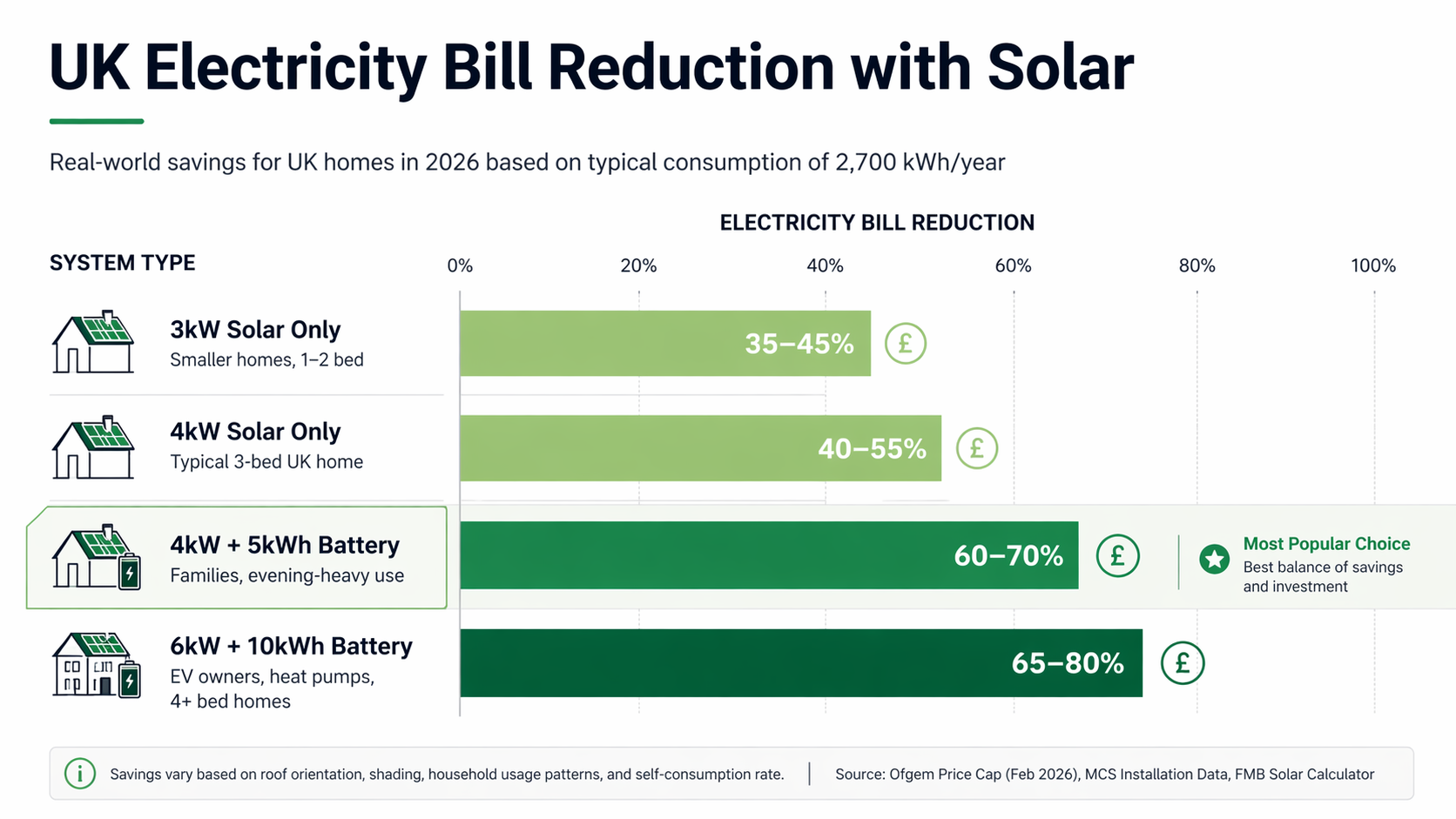
Here’s the honest range for UK homes in 2026, based on Ofgem’s updated typical consumption figure of 2,700 kWh/year and current cap rates:
Sources: Ofgem price cap (current and forthcoming), FMB solar calculator, MCS installation data
Where most guides mislead readers: they calculate savings assuming you’ll use every kWh your panels produce. Reality is different. Without a battery, UK homes self-consume 35–50% of solar generation. The rest gets exported to the grid under the Smart Export Guarantee (SEG) at 7.9–15p/kWh. You still get paid for exported electricity, but not at the grid import rate you’d otherwise save.
In our experience, self-consumption rate is the single biggest number homeowners miscalculate when estimating solar savings on their own.
🎯 Want to know your exact bill reduction? Book a free AORO assessment — we’ll calculate your specific self-consumption rate based on your actual usage, not generic UK averages.
What Does Solar Actually Cost in 2026?
UK solar prices in February 2026 range from £5,000 for a small system to £14,500 for a premium setup with battery storage. The exact figure depends on four variables: system size, battery inclusion, roof complexity, and installer quality.
Current UK Solar Installation Prices
These figures assume the 0% VAT relief on residential solar, which runs until 31 March 2027. After that, expect 5% VAT added back to the total.
Where Your Money Actually Goes
A £7,000 installation typically breaks down into three cost categories:
- Hardware (45–55%): Panels £2,500–£3,200, inverter £800–£1,200, mounting £400–£700
- Labour (20–30%): Electrical installation, DNO notification, commissioning
- Logistics (15–25%): Scaffolding £500–£900, MCS registration £150–£300
The pricing red flag: any quote above £2,200 per kWp for a straightforward installation indicates overpricing. The national median from DESNZ data sits at £1,565 per kWp for England in 2026.
Worked Example: A Typical UK Home’s Savings
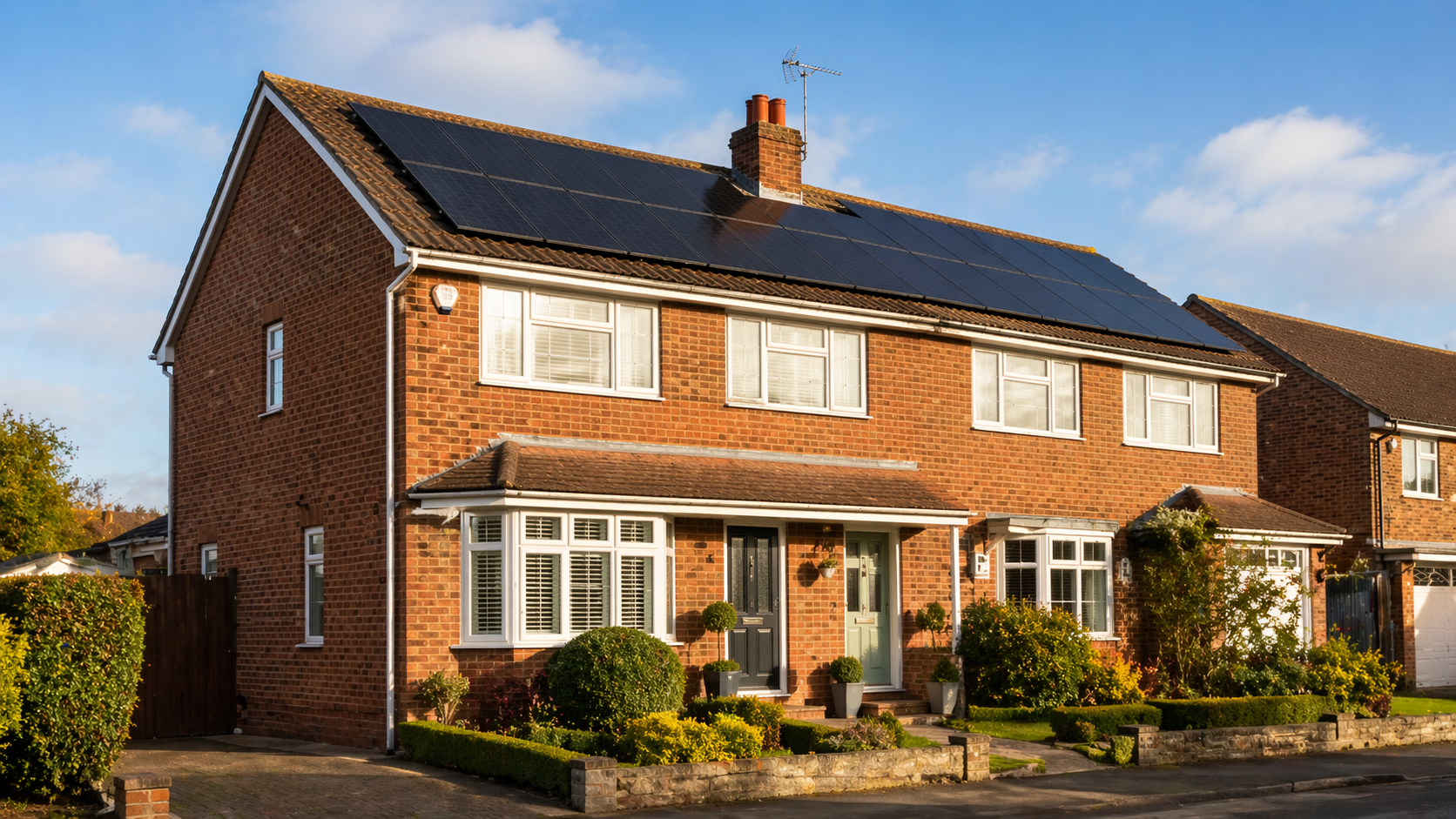
Consider a realistic scenario. A 3-bed semi-detached home in the South East:
- Annual electricity use: 3,400 kWh (slightly above the UK average)
- Current annual electricity bill: ~£942 at 27.69p/kWh (current cap rate)
- Roof: South-facing, 30° pitch, minimal shading
- System installed: 4kW solar + 5kWh battery
- Total cost: £10,500 (with 0% VAT)
Year 1 Financial Breakdown
On payback: at current energy prices, a system like this breaks even around year 13–15. However, the actual payback period is sensitive to several moving variables — future tariff movements, changes to SEG export rates, standard panel degradation (0.5–0.8%/year), and the inverter replacement expected around year 12. Rising electricity prices tend to shorten payback; falling prices extend it.
25-year outlook: based on reasonable assumptions about energy price trends, the net lifetime benefit typically falls between £15,000 and £25,000 for a system of this size. That range accounts for the inverter replacement and gradual output decline.
Are Solar Panels Worth It in the UK? The Honest Answer
For approximately 65% of UK homes, yes. For the other 35%, no. The difference comes down to five factors:
- Roof orientation: South, south-east, or south-west = worthwhile. North-facing = usually not.
- Shading: Under 20% = manageable. Over 30% = major problem.
- Electricity usage: £100+/month = fast payback. Under £60/month = marginal case.
- Time in property: 8+ years = solid return. Under 5 years = probably not.
- Lifestyle: EV owners and heat pump users see the fastest payback.
If you tick four or more of these, solar is almost certainly worth it. If you tick two or fewer, the £7,000 is better spent elsewhere. This is why AORO turns down roughly 1 in 5 enquiries — when the fundamentals don’t align, we say so upfront rather than install a system that will disappoint.
Five Ways to Maximise Your Solar Savings
Installation quality matters. So does how you use the system after commissioning. Here’s what experienced installers wish every customer knew before the first panel goes up:
1. Shift Heavy Appliances to Daylight Hours
Run your washing machine, dishwasher, and tumble dryer between 10am and 4pm when solar output peaks. Every kWh used directly saves the grid rate (27p currently, 24.67p from April) instead of earning the 12p SEG export rate. Over a year, this habit alone adds £150–£250 to your savings.
2. Switch to the Best SEG Tariff
You don’t have to export to the same supplier you import from. Octopus Outgoing pays 12p/kWh while some suppliers offer as little as 4p. On a typical 4kW system, the difference is £100–£150/year.
3. Size the System for Your Actual Usage
Oversizing is a common mistake. A 6kW system on a home using 2,700 kWh/year means exporting the majority of generation at low SEG rates. You’d typically save more with a 4kW system plus a battery that shifts evening consumption into daylight-generated electricity.
4. Add Battery Storage Strategically (Not Automatically)
Batteries cost £3,000–£7,000 and save £290–£450/year. Standalone payback is 10–15 years. They make strong financial sense for evening-heavy households on time-of-use tariffs, less so for daytime-at-home households already self-consuming 50%+ of generation.
5. Choose an MCS-Certified Installer
MCS certification is non-negotiable for SEG registration. Non-certified installers may be 10–15% cheaper, but the lost SEG income over 25 years (£2,500–£5,000) comfortably exceeds any upfront saving.
Three Mistakes UK Homeowners Make
Accepting the First Quote
The same 4kW specification can vary by £1,500–£2,500 between MCS installers. Always get three quotes and compare cost per kWp — anything over £2,200/kWp signals overpricing, while anything under £1,400/kWp often means sub-tier panels or cutting corners somewhere.
Skipping the Shading Analysis
A single shaded panel can drop an entire string’s output by 30–50%. Proper installers use satellite data and hour-by-hour sun path modelling. If your installer is eyeballing shade from the van, walk away.
Forgetting About the Inverter
String inverters last 10–15 years while panels carry 25-year warranties. Budget £800–£1,200 for replacement around year 12. If your quote doesn’t line-item this, you’re being misled about the true 25-year cost.
At AORO, we turn down roughly 1 in 5 enquiries.
If your roof, usage, or timeline don’t add up, we say so. Protecting your £7,000 matters more to us than closing another sale.
Calculate Your Exact Savings (Free, 15 Minutes)
Generic UK averages don’t help you. What matters is your roof, your postcode, your usage, your bill.
In a free 15-minute assessment, AORO delivers:
- ✅ Exact bill reduction based on your current consumption
- ✅ Realistic payback period for your specific roof — not UK averages
- ✅ Proper shading analysis with PV*SOL software
- ✅ Line-itemised quote — no bundled mystery charges
- ✅ Honest verdict — including “don’t do it” when that’s right
- ✅ Financing options with exact monthly figures
Typical response time: same working day. Limited to six assessments per week to ensure quality. No sales pressure. No follow-up spam.
We don’t sell solar to everyone. Only where the numbers work.
Frequently Asked Questions
How much can solar panels reduce my UK electricity bill?
A typical 4kW solar system reduces electricity bills by 40–55% for most UK homes. Adding a 5kWh battery increases this to 60–70%. The exact figure depends on roof orientation, usage patterns, and self-consumption rate. Note that solar reduces electricity imports only — gas bills remain unaffected.
How much do solar panels cost in the UK?
UK solar panel installation costs range from £5,000 for a 3kW system to £14,500 for a 6kW system with battery storage. A standard 4kW system costs £5,500–£7,500 fully installed with 0% VAT, which runs until March 2027.
Are solar panels worth it in the UK in 2026?
Yes, for approximately 65% of UK homes — those with south-facing roofs, minimal shading, electricity bills over £100/month, and plans to stay 8+ years. Solar is not worth it for north-facing roofs, heavily shaded properties, or homeowners moving within 5 years.
How long do solar panels take to pay for themselves?
Solar-only systems typically pay back in 8–12 years at current electricity prices. Systems with battery storage take 10–14 years. Homes with EVs or heat pumps see faster payback of 7–10 years due to higher self-consumption. Payback periods are sensitive to future tariff changes and panel degradation.
Will solar panels work in UK weather?
Yes. Modern solar panels generate electricity from daylight, not heat. They still produce 10–25% of peak output on overcast days. UK systems operate year-round, with winter generation at 20–30% of summer levels.
Do I need a battery with my solar panels?
Not necessarily. Without a battery, UK homes self-consume 35–50% of generated electricity. A battery pushes this to 60–80%, adding £290–£450/year in savings. Batteries make most sense for evening-heavy households and EV owners.
Is there still government support for solar panels?
Yes. The 0% VAT on residential solar installations applies until 31 March 2027. The Smart Export Guarantee pays 7.9–15p/kWh for exported electricity. Scotland offers additional grants through Home Energy Scotland (up to £7,500).
What is the Smart Export Guarantee (SEG)?
The SEG is a UK scheme requiring large energy suppliers to pay homeowners for surplus solar electricity exported to the grid. Rates range from 4p to 15p per kWh. Importantly, you can use different suppliers for import and export.
How long do solar panels last?
Solar panels carry 25-year performance warranties with typical degradation of 0.5–0.8% per year. Physical lifespan often exceeds 30 years. Inverters need replacement every 10–15 years at £800–£1,200.
Do I need planning permission for solar panels in the UK?
No, for most residential installations. Solar panels fall under permitted development rights. Exceptions include listed buildings, conservation areas, and installations exceeding 200mm from the roof slope. Always confirm with your local planning authority before installation.
The Bottom Line
UK energy bills remain 44% above pre-crisis levels, and wholesale gas prices will continue setting electricity costs for years to come. Solar is the only tool that genuinely removes you from this equation — cutting your grid electricity dependence by 40–70% and locking in your generation cost for 25 years.
But it’s not for everyone. North-facing roofs, short-stay homeowners, and very low usage households typically see better returns elsewhere. The 0% VAT window closing on 31 March 2027 creates a genuine deadline — after that, the same installation costs 5% more.
If you’re in the 65% of UK homes where solar makes sense, the financial case is compelling: £15,000–£25,000 net lifetime benefit, plus meaningful independence from whatever Ofgem announces next quarter.
The first step is a proper assessment — not a sales pitch, not a generic estimate, but actual numbers based on your specific home.
⚡ Ready to see what solar could save on your electricity bill? Get a free solar quote from AORO Solar — MCS-certified, engineering-led, no commission-driven nonsense. Same-day response, no sales pressure.

Comments are closed