
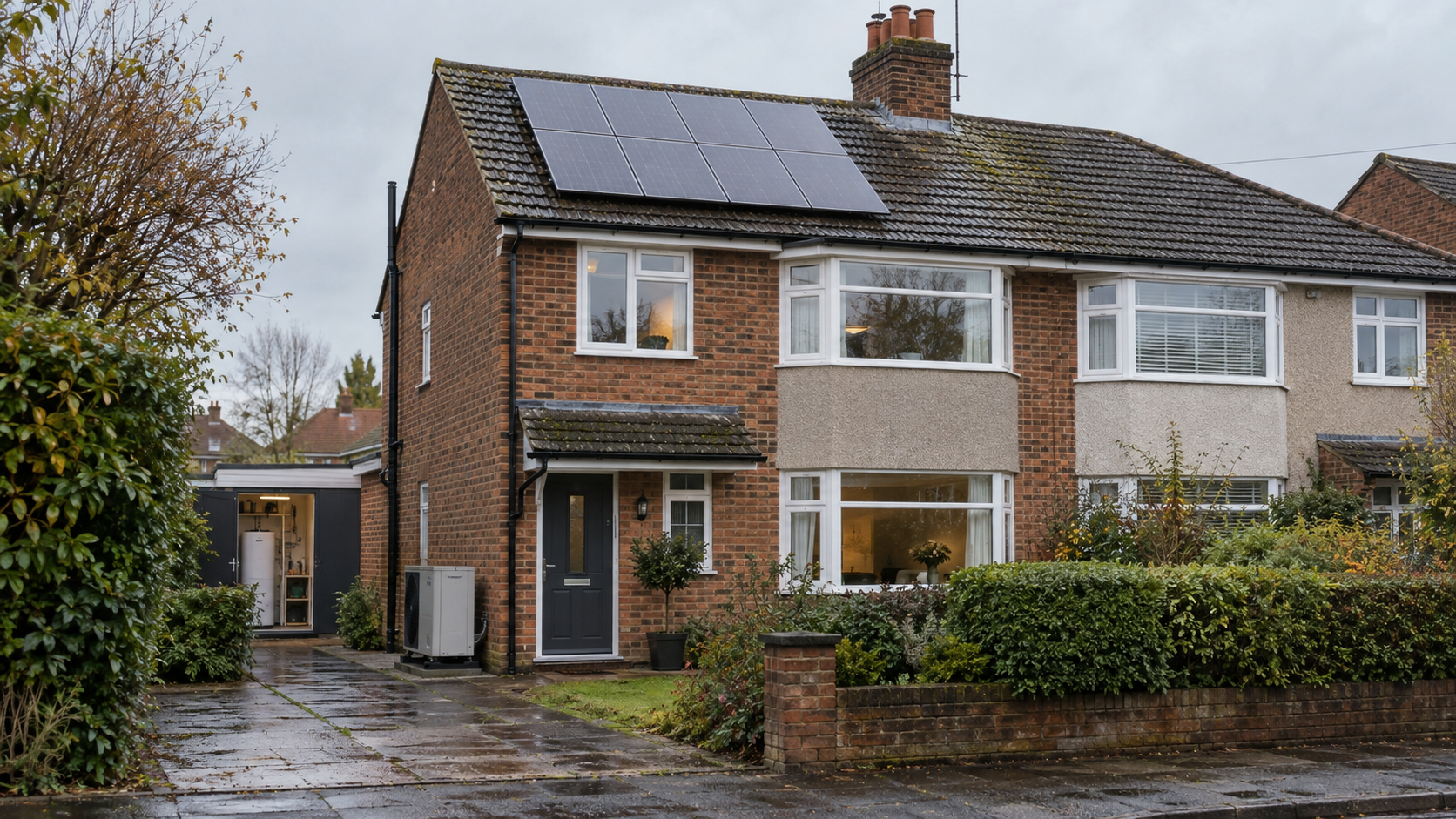
Warm Homes Plan 2026: What It Means for Solar and Batteries
A practical guide to the Government’s £15 billion programme, the difference between a policy announcement and an open funding route, and how households can prepare without making assumptions.
Warm Homes Plan 2026 solar panels have become a prominent search because the policy brings together energy-efficiency upgrades, low-carbon heating, rooftop generation and storage. The important point is that the Warm Homes Plan is not a single voucher that every homeowner can claim. It is a national framework delivered through several routes, each with its own timetable, administrator and eligibility rules.
The Government published the Warm Homes Plan on 21 January 2026 and updated the document on 18 March. Its stated ambition is to support improvements in up to five million homes by 2030 and help up to one million families out of fuel poverty. The public-investment commitment is £15 billion. Those are programme-level commitments; they are not a promise that an individual household will receive a particular technology, grant value or installation date.
Understand what your home needs before choosing a route
A roof, demand and electrical assessment can separate a technically sound project from a grant-led guess. AORO can review solar, battery, EV and heat-pump readiness as one energy system.
What the Warm Homes Plan actually is
The plan is intended to lower bills, improve comfort and accelerate the move to cleaner domestic energy. It combines direct support for eligible households with finance intended to make upgrades more accessible to a wider market. It also connects to wider policy: stronger standards for new homes, local-authority delivery, consumer protection, workforce capacity and the growth of distributed energy resources.
For a homeowner, the most useful way to read the plan is as a map rather than a coupon. It shows which technologies government wants to scale and the funding architecture being developed. The live opportunity, however, is always the named scheme beneath that architecture. Before relying on support, check whether the scheme is open, who administers it, whether your postcode is covered, what evidence is required, and whether the installer and product rules match the proposed design.
| Published element | What it means | What it does not mean |
|---|---|---|
| £15bn public investment | A multi-year national commitment across Warm Homes delivery | £15bn is not available through one household application form |
| Up to £2.7bn in grants | Targeted grant support is part of the plan | Every property or measure is not automatically eligible |
| £2bn low-interest loans | Finance is intended to support technologies including solar and batteries | A product should not be described as open until its terms and route are published |
| Up to five million homes | The scale of the 2030 ambition | It is not a guaranteed delivery number for a particular year or region |
Grants, finance and zero-rate VAT: keep the routes separate
Targeted grants
The plan allocates up to £2.7 billion for grants, with an emphasis on households facing affordability and fuel-poverty pressures. Delivery can include local-authority and social-housing routes rather than a direct national form for every measure. The Warm Homes: Local Grant guidance, for example, names solar panels among eligible measures, but councils and delivery partners control local implementation within the programme rules.
A legitimate enquiry should therefore start with the responsible body. Ask for the current guidance, application window, eligibility test and approved delivery process. Do not pay an intermediary merely because it uses the words “Warm Homes” in an advert. A genuine scheme can be traced to GOV.UK, the relevant council, registered provider or named programme administrator.
Low-interest finance
The Warm Homes Plan also sets out £2 billion for low-interest loans covering technologies that can include solar panels, batteries and heat pumps. This is commercially significant because many households do not qualify for a means-tested grant but still need a finance route with transparent costs and consumer protections. The announcement should not be confused with a live lender offer. Rates, credit checks, eligible technologies, launch dates, security and early-repayment terms must be read from the final product documents.
Zero-rate VAT
Under current policy, qualifying energy-saving materials installed in eligible residential and charity buildings are zero-rated for VAT until 31 March 2027. Solar panels and electrical storage batteries are included within the relevant rules, including certain standalone battery installations. Tax treatment can depend on the nature of the supply and property, so a quotation should state the VAT basis rather than relying on a headline.
Where solar panels, batteries and heat pumps fit
The strongest outcome is not achieved by selecting technologies in isolation. Solar generation changes the daytime electricity profile. A battery changes when that generation can be used. A heat pump can increase electrical demand while reducing fossil-fuel use. An EV charger can add a large controllable load. The design task is to understand how these assets interact across a typical weekday, weekend and winter peak.
For Warm Homes Plan 2026 solar panels, roof area is only the first filter. Orientation, shading, roof condition, structural constraints, inverter position, consumer-unit capacity, export limitations and future loads all affect the design. A south-facing roof is not mandatory, but yield and time-of-day generation will vary. Any production figure should be modelled for the property and presented as an estimate with assumptions.
A home battery storage system can increase self-consumption and may support time-of-use tariff strategies. It should be sized from interval consumption, expected solar surplus, charge and discharge power, usable capacity, reserve settings and the customer’s objective. A bigger battery is not automatically a better investment. If it regularly finishes the day partly full or cannot charge from available surplus, capacity may be underused.
A heat pump requires a separate heat-loss and emitter assessment. Combining technologies can be sensible, but “whole-home” should mean coordinated engineering, not a bundle assembled for a funding form. See AORO’s guidance on heat-pump solutions and solar and battery systems for the practical design questions.
| Technology | Primary job | Evidence needed before design |
|---|---|---|
| Solar PV | Generate electricity on site | Roof survey, shading, annual and interval demand, network constraints |
| Battery storage | Shift electricity between times | Solar surplus, evening load, tariff, power rating, backup requirement |
| Heat pump | Provide low-carbon space and water heating | Room-by-room heat loss, emitters, hot-water profile, electrical supply |
| EV charger | Charge a vehicle safely and intelligently | Mileage, dwell time, charger location, supply capacity, tariff |
A practical household checklist
First, identify your objective. Lower annual bills, resilience, reduced peak import and lower carbon emissions are related but not identical. A system optimised for backup may retain more battery reserve; a system optimised for tariff arbitrage may cycle differently; a system designed around an EV may prioritise daytime charging.
Second, gather evidence: twelve months of electricity bills, half-hourly data where available, property plans, roof information, heating fuel use and expected changes such as an EV or extension. This allows an installer to model a range instead of presenting a universal savings percentage.
Third, verify the funding source independently. Use the official Warm Homes Plan, local-authority pages and the named administrator. Record the version and date of any guidance. A screenshot of an advert is not evidence of eligibility.
Fourth, compare proposals on the same basis. Check equipment model numbers, usable battery capacity, inverter power, estimated generation assumptions, exclusions, scaffolding, network applications, monitoring, workmanship cover and aftercare. Where a figure depends on future tariffs or export rates, it should be shown as a scenario, not a certainty.
Finally, treat the funding timetable and installation timetable as separate. A technically ready project can still wait for approval; an approved measure can still require survey, design and network coordination. Keeping those stages distinct reduces rushed decisions and makes quotations easier to audit.
How to recognise a credible Warm Homes offer
A credible offer names the exact scheme and delivery body. It links to the current guidance, explains why the property and applicant appear eligible, and makes clear which points still require verification. It does not create artificial urgency by claiming that a national fund will disappear that afternoon, and it does not ask for a large payment merely to “secure” an application place.
The technical proposal should stand on its own even if funding changes. It should identify the products, explain sizing, state assumptions, show what is included and excluded, and distinguish estimated performance from contractual scope. Where finance is involved, the total amount payable, interest basis, term, fees and cancellation rights deserve as much attention as the monthly figure.
Households should also check the route for complaints and aftercare. Public support does not remove the need for competent installation, commissioning or support. Record who is responsible for each stage: scheme administrator, surveyor, principal contractor, installer, finance provider and equipment manufacturer. If several organisations are involved, the customer should not be left to discover those boundaries only after a fault occurs.
How to build a decision-ready project before funding opens
A household can prepare without pretending that a future scheme is already open. The first document should be a short energy brief: current annual consumption, available half-hourly data, heating fuel, daytime occupancy, planned EV use, comfort issues and the reason for considering storage. This prevents the technology conversation from beginning with a package size. It also creates a stable basis for comparing later quotations, even if the funding route or equipment market changes.
Separate the technical case from the funding case
The technical case asks whether the property is suitable and what configuration would serve it. The funding case asks whether a named programme can support that configuration for this applicant and address. Both matter, but they use different evidence. A roof survey cannot prove financial eligibility, and an eligibility letter cannot prove that a proposed array is structurally, electrically or commercially sensible. Keeping two decision files avoids the common mistake of treating approval for support as approval of the design.
A useful technical file includes a measured roof layout, shading observations, photographs, likely cable and equipment locations, consumer-unit information, import and export constraints, and the assumptions used for energy modelling. A useful funding file includes the official guidance version, eligibility evidence, administrator correspondence, deadlines and any procurement rules. When a condition changes, the household can see which part of the decision must be revised.
Compare scenarios, not sales headlines
Ask for at least two technically coherent scenarios. A solar-only case shows the value of direct self-consumption and export. A solar-and-battery case shows how storage changes import timing, usable surplus and resilience. Where a heat pump or EV is planned, a future-demand case should explain how the load profile may change. The comparison should use the same consumption data, tariff assumptions and evaluation period so that differences come from the design rather than from selective modelling.
Scenario results should be ranges. Weather varies, household behaviour changes and tariffs are not fixed for the operating life of the equipment. A responsible model states the source of irradiation data, losses, degradation assumption, battery usable capacity, cycling policy and import/export prices. It also distinguishes cash purchase from finance: interest and fees can materially change a monthly-saving claim even when the engineering is identical.
Plan the delivery sequence
Once a preferred system is identified, map the dependencies. Structural review may be needed before final layout. A distribution network application can affect inverter or export-control choices. Scaffolding, roof repairs and other home works need coordination. Battery position requires fire, access, temperature and cable-route consideration. The installation date should therefore follow design acceptance and required approvals, not precede them.
The handover should be specified before the contract is signed. Ask for the final equipment schedule, layout, electrical diagram, commissioning evidence, network documents, warranties supplied by the relevant parties, monitoring access and emergency instructions. Confirm who responds if the system stops reporting and what is included in aftercare. These details turn a funded installation into an operable household asset.
This preparation remains valuable if no grant is available. It allows the homeowner to decide whether to proceed independently, wait for a verified route or stage the project. It also reduces exposure to urgent marketing because the household already knows which evidence is missing. Funding can then accelerate a sound plan instead of determining it.
Before accepting a final proposal, ask the installer to walk through the design using the same evidence supplied at enquiry. The explanation should connect roof layout to generation, consumption to battery sizing, electrical constraints to equipment selection and the customer’s priorities to operating settings. Record outstanding assumptions and who will resolve them. This short design review often reveals discrepancies that a product schedule alone cannot show, and it gives the household a clear reference if the scope changes before installation.
What the Warm Homes Plan changes commercially
The plan gives households a clearer signal that generation, storage and electrified heat are becoming part of normal home infrastructure. It also raises the standard expected from installers. As public support grows, so does the need for traceable assumptions, clear consumer communication and designs that work after the funding headline has passed.
For AORO Solar, the practical response is engineering-led: assess the property, model realistic scenarios and specify a system that can be explained line by line. If support is available, it should improve access to a sound project. It should never be used to justify unsuitable equipment, an inflated package or an unverified savings claim.
Frequently Asked Questions
No. The plan is delivered through specific schemes. The correct application route depends on the programme, location, delivery body and eligibility criteria.
The published plan includes batteries among technologies supported through grants and low-interest finance. Confirm current availability against the live scheme before relying on it.
Qualifying installations remain zero-rated until 31 March 2027 under current rules. The exact treatment depends on the installation and customer circumstances.
Not necessarily. A survey can establish what is technically suitable. Do not sign a grant-dependent contract until the scheme and your eligibility are confirmed.
No. Grant, finance and local delivery routes have different criteria, budgets and availability.
Official sources and further reading
- GOV.UK — Warm Homes Plan
- GOV.UK — technical annex
- GOV.UK — Warm Homes: Local Grant
- HMRC — VAT on energy-saving materials
Funding should support the right system, not define it
The Warm Homes Plan creates meaningful routes for cleaner, more efficient homes, but the household decision still begins with evidence. Confirm the scheme, understand the property and compare designs on equal terms.
Model your home before committing
Start with AORO’s solar assessment and request an engineering-led proposal for solar, storage and future electrical loads.

Comments are closed