
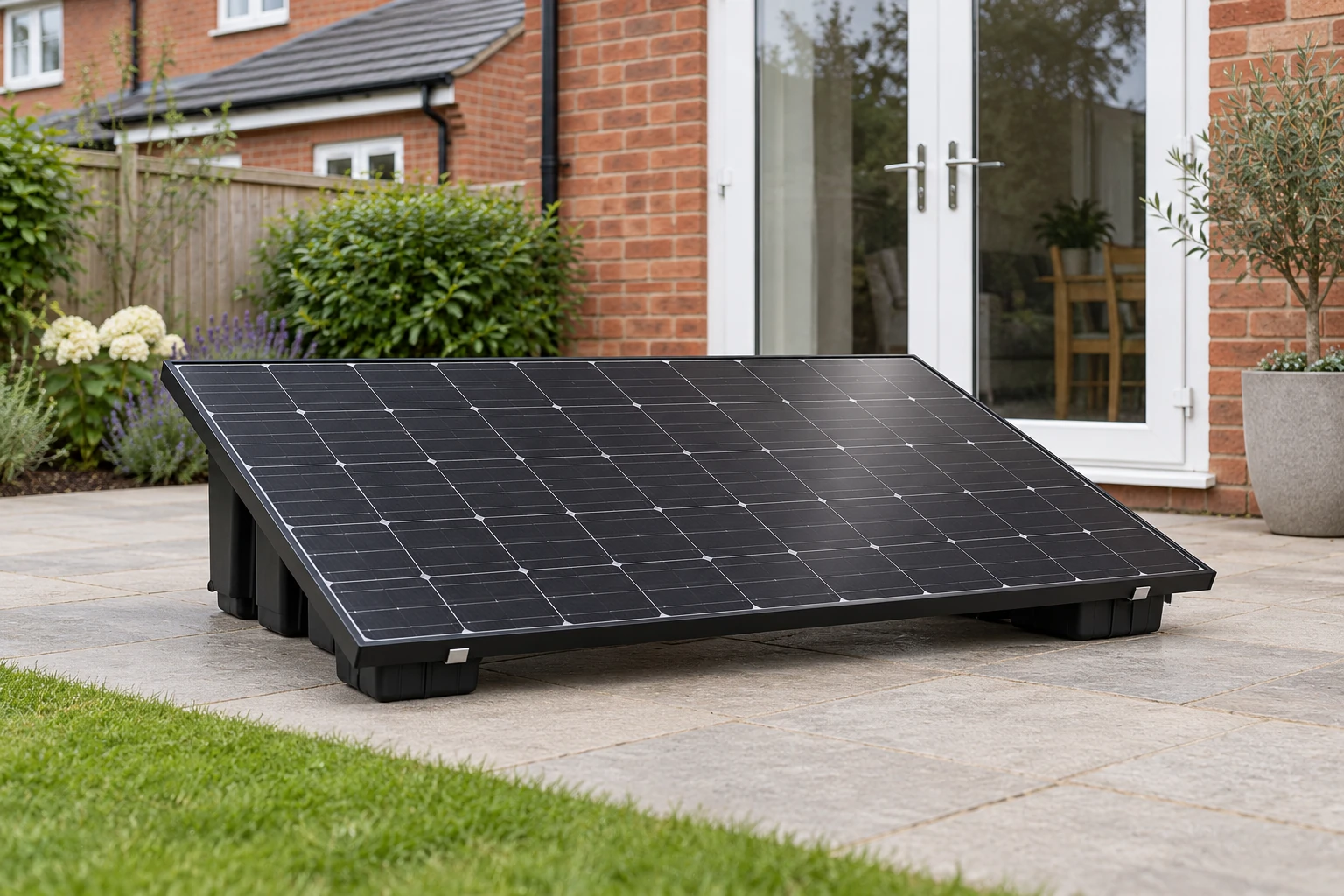
What are plug-in solar panels?
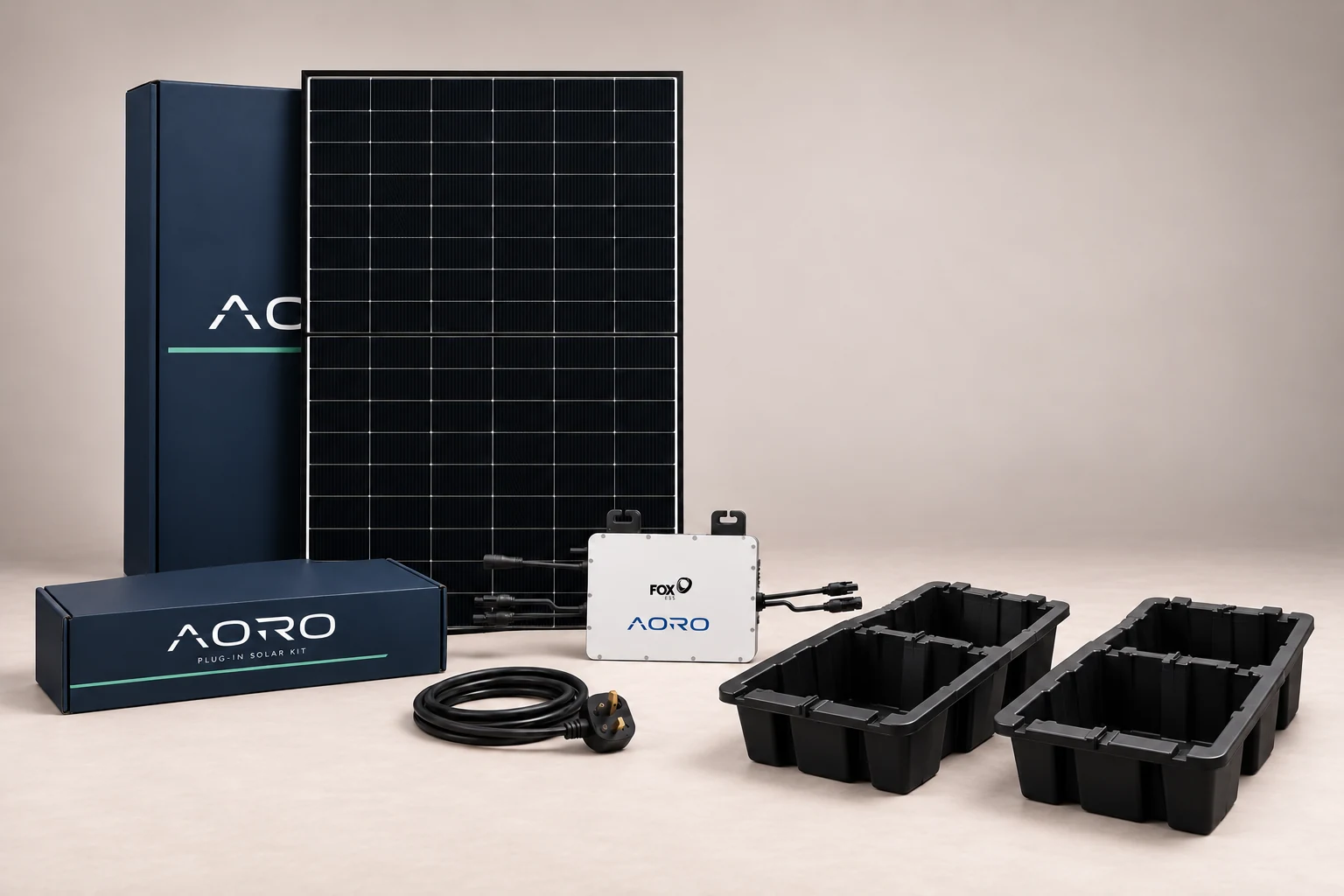
Plug-in solar panels are compact photovoltaic systems that generate electricity alongside a home’s normal grid supply. A complete kit combines the panel or panels, a matched microinverter, a UK connection lead and mounting equipment. The inverter converts direct current (DC) from the panels into alternating current (AC) for the home.
Plug-in solar panels cover part of daytime electricity demand. A fridge, router or home-office equipment can use solar while it is being generated; the grid supplies any shortfall. Electricity that the home does not use may flow out to the network. A grid-connected solar-only kit does not store that surplus for the evening.
For UK households comparing plug-in solar panels, the useful distinction is between a complete product designed for the plug-in route and a collection of individually rated components. A familiar panel brand or an 800 W label on an inverter does not, by itself, describe the safety, connection or mounting requirements of the assembled system.
Plug-in solar panels UK: the official data
Three different types of evidence matter: national solar statistics, current electricity prices and the rules for the complete plug-in device. Keeping them separate prevents a national headline being mistaken for a household’s forecast.
| Measure | Reported figure | Period / geographical scope | Interpretation |
|---|---|---|---|
| Solar installations | More than 2.1 million | DESNZ September 2026 release; UK solar fleet | All solar installations, not a plug-in-only count |
| Solar electricity generation | 8.4 TWh | April–June 2026; whole UK solar fleet | National generation; not output from one kit |
| Electricity unit price | 26.32p/kWh | October–December 2026; GB Direct Debit average | Benchmark for imported electricity avoided |
| Electricity standing charge | 54.83p/day | October–December 2026; GB Direct Debit average | A compact kit does not remove this charge |
| Plug-in launch | 27 August 2026 | Great Britain; DESNZ launch announcement | Compliant products, not unrestricted DIY generation |
Sources: DESNZ — Energy Trends, September 2026 ↗ · Ofgem — electricity unit rates and standing charges ↗ · DESNZ — Great Britain plug-in solar launch ↗
The national generation figure includes large solar farms and rooftop systems. It is evidence that solar contributes to the UK electricity mix, not a measurement of balcony or garden kits. DESNZ reported a record first half of 2026 for the number of new solar installations; that observation should also be described as solar-wide.
For a household decision, look beyond adoption totals. Two neighbours buying the same kit may save different amounts because one has shade at midday and the other works from home. National statistics establish the wider context; site conditions and demand determine the result at an individual property.
Are plug-in solar panels legal in the UK?
The government’s launch announcement says compliant plug-in solar became available for use in Great Britain from 27 August 2026. Great Britain means England, Scotland and Wales. Northern Ireland has a separate electricity and product-regulation context; do not assume the GB connection route applies unchanged there.
The current DESNZ interim product specification is version 2.0, July 2026. It limits a device’s mains output to 800 VA and 3.5 A, while allowing up to 2,000 W of panel DC capacity. Its notes distinguish one device per final circuit from the network restriction of one device per household under the cited G98 arrangements. It excludes plug-in batteries and solar devices incorporating batteries.
Sources: DESNZ — Great Britain plug-in solar launch ↗ · DESNZ — final interim product specification, version 2.0 ↗
On 11 August 2026, Ofgem approved the G98 amendment for plug-in microgeneration. Ofgem explicitly separates network operation from wider product legality, consumer protection and electrical safety inside a home. A network assessment is therefore not a substitute for checking the complete product’s documentation.
Sources: Ofgem — approved G98 plug-in microgeneration amendment ↗
For buyers, ask for the exact kit designation, its supplied instructions and the applicable complete-device compliance information. Keep these with the component model numbers and serial numbers. A product image, a generic CE statement or an inverter datasheet alone is not the full record of the assembled kit.
Keep the exact kit’s product and network documents with your purchase record, particularly when choosing a different panel manufacturer. The UK government’s launch estimate of up to £110 annual savings and up to 20% of average home electricity use is a category-level illustration, not a promise for every product or address.
What do plug-in solar panels cost?
AORO’s Single Panel kit costs £385; Dual Panel costs £585. Both include VAT, UK kerbside delivery, one Fox ESS M1-800-E microinverter, a special 5 m UK connection lead, FoxCloud 2.0 monitoring access, the selected complete ground or wall mounting kit and assembly instructions. Delivery is three weeks from order confirmation.
| Item | Single Panel | Dual Panel |
|---|---|---|
| Kit price, VAT & UK delivery included | £385 | £585 |
| Solar panels | 1 selected panel | 2 matching selected panels |
| JA Solar / AIKO DC capacity | 460 W | 920 W |
| DMEGC DC capacity | 500 W | 1,000 W |
| Microinverter | 1 × Fox ESS M1-800-E | 1 × Fox ESS M1-800-E |
| Nominal inverter AC rating | 800 W | 800 W |
| Supplied UK connection lead | 1 × 5 m | 1 × 5 m |
| Ground mounting choice | 2 supports, rails & clamps | 3 supports, rails & clamps |
| Wall mounting choice | 6 brackets & wall fixings | 12 brackets & wall fixings |
For these plug-in solar panels, the kit price difference is £200. Treat that as the cost of moving to the larger kit, not as evidence that useful generation or savings will double. Two panels need more space and share the same nominal 800 W AC inverter rating. Their extra DC capacity can help in lower light, while the inverter still constrains AC output.
Prepare a realistic total budget. Site-specific ground ballast, tools, safe handling assistance and any required electrical preparation are separate. If a socket, protective device or wall needs work, include that cost before comparing payback. “Mounting kit included” means the supplied equipment; it does not mean an installer will complete work at the property.
Compare the Single Panel kit or see the Dual Panel kit. Read the selected variant’s original specifications before choosing.
How much can plug-in solar panels save?
Use the electricity unit rate on your own bill. Ofgem’s GB Direct Debit average is 26.32p/kWh for 1 October–31 December 2026. Regional rates, payment methods and fixed or time-of-use tariffs can differ. Ofgem also reports a 54.83p daily electricity standing charge for that period; generating some electricity does not remove it.
Sources: Ofgem — electricity unit rates and standing charges ↗
Annual import saving = annual generation × share used at home × avoided import rate. Export payments, if available, are a separate calculation. For example, 400 kWh generated × 70% used at home × £0.2632/kWh = £73.70 of avoided imports. The remaining 120 kWh is not an extra £31.58 import saving. Any export value must be calculated separately at the accepted export tariff.
| Share used at home | Energy used at home | Avoided import value at 26.32p/kWh | £385 ÷ saving, kit cost only |
|---|---|---|---|
| 40% | 160 kWh | £42.11/year | 9.1 years |
| 70% | 280 kWh | £73.70/year | 5.2 years |
| 90% | 360 kWh | £94.75/year | 4.1 years |
These are AORO arithmetic scenarios, not measured results, a PVGIS simulation or a production guarantee. Holding generation constant shows why household timing matters. The simple cost-recovery column excludes extra preparation, maintenance, output degradation, financing, future tariffs and export income. It is not a prediction of your actual payback.
Estimate savings from plug-in solar panels in two stages. First model the site’s generation; then estimate how much coincides with demand. If nobody is home during the day, a high output figure can still produce a modest import saving. If you regularly use electricity while solar is available, more of that generation may have immediate value.
A time-of-use tariff needs a finer calculation: value each period’s solar consumption at the import rate it actually avoids. Multiplying everything by an expensive evening rate overstates savings when the kit produces mainly in daylight. Solar output in kWh and money saved in pounds are related, but they are not the same measurement.
Do plug-in solar panels work in cloudy UK weather?
Photovoltaic panels respond to light rather than needing warm weather. Cloud, shade, orientation and seasonal daylight still affect output. Winter generation can be much lower than summer generation, and a wall facing the wrong direction can perform differently from an open garden position. A panel’s printed wattage is a test-condition rating, not a constant output.
A useful estimate records the location, panel capacity, tilt, direction and losses. The European Commission’s PVGIS modelling tool provides location-based solar estimates. Keep its input settings and monthly results with the estimate so another reader can reproduce it. The tool’s calculated horizon is not a survey of a nearby fence, tree or extension.
For an AORO ground position, the selected support has an 18° listed pitch. Use the actual completed arrangement and orientation in a model; do not assume an optimum rooftop angle. For the Dual kit, an estimate must also consider the 800 W nominal AC inverter rating rather than treating panel DC capacity as unconstrained AC output.
For monitoring, compare like-for-like periods and note changes in shading. FoxCloud 2.0 shows generation for the microinverter; it does not automatically prove how much electricity your home consumed from the kit or the exact pounds saved. A household demand or meter record is needed to connect generation to self-consumption.
When comparing plug-in solar panels, prefer a reproducible estimate to an unsupported “up to” number. Ask whether the claimed result assumes south-facing panels, clear access to daylight, a particular tariff and a high share used at home. A sound comparison states those assumptions rather than hiding them.
One panel or two: compare size as well as watts
| Panel | Model / rated DC power | Dimensions | Weight |
|---|---|---|---|
| JA Solar | JAM54D41-460/LB · 460 W | 1762 × 1134 × 30 mm | 22 kg |
| AIKO | AIKO-A460-MAH54Mb · 460 W | 1757 × 1134 × 30 mm | 21.5 kg |
| DMEGC | DM500M10RT-B60HBT/HST · 500 W | 1950 × 1134 × 30 mm | 26.8 kg |
The DMEGC option has a higher panel rating but is also larger and heavier. Measure the proposed position and the route from kerbside delivery before ordering. For Dual, both panels are the same selected manufacturer option. Allow for the whole mounting arrangement and working clearance; panel dimensions are not a complete installation footprint.
Both AORO sizes use one Fox ESS M1-800-E. A Single 460 W panel does not become an 800 W generator because it is paired with an 800 W-class microinverter. Conversely, two 500 W panels have 1,000 W combined DC capacity, while mains output remains constrained by the inverter and the applicable product limits.
The current government specification advises considering professional assessment of the existing electrical installation when total panel capacity is above 960 W. That is relevant to the 1,000 W DMEGC Dual option. It is advice about installation suitability, not a statement that a 1,000 W DC panel total means 1,000 W can be fed into the home.
Sources: DESNZ — final interim product specification, version 2.0 ↗
Compare warranty documents separately from wattage. A panel product warranty concerns specified defects; a performance warranty concerns its stated long-term output terms. The inverter has its own policy. Keep the invoice, model and serial number and read the eligibility and exclusions in the original documents.
Open the panel specifications and original PDFs. There is one AORO Single product and one Dual product, with JA Solar, AIKO and DMEGC choices inside each; the manufacturers are options rather than separate kit pages.
Where can you put a plug-in solar kit?
A suitable garden or patio position for plug-in solar panels needs daylight, a stable surface, clear routes and a cable path to the socket. Ground mounting uses ballasted supports; the weight and placement must follow the supplied instructions for the site. The support dimensions are 1017 × 695 × 507 mm per tub. Single uses two supports and Dual uses three, with the specified rails and clamps.
The AORO wall choice uses six brackets per panel, three at the top and three at the bottom, on assessed masonry. Dual therefore uses twelve brackets. Use fixings suited to the wall and follow the kit’s fixing instructions. A picture of a wall installation is not a drilling template, and a panel drawing does not establish anchor positions or wall strength.
These AORO choices are ground or masonry-wall arrangements. A balcony railing, timber fence, roof or portable support is not automatically the same mounting system. Leave clearance for doors, paths, maintenance and ventilation, and consider whether moving or removing the equipment will be practical later.
Property permission remains separate from electrical connection. Renters should obtain the necessary landlord consent; leaseholders may need freeholder or building-owner permission. Listed buildings, protected sites and local planning restrictions can change the position. The Planning Portal guidance linked here is for England; consult the relevant local authority for Wales, Scotland or Northern Ireland.
Sources: Planning Portal — solar equipment on homes in England ↗ · DESNZ — Great Britain plug-in solar launch ↗
Compare the mounting arrangements and download the AORO owner manual. Plan a safe position first, then choose the panel and mounting option that actually fit.
Can you simply plug it into a socket?
A prepared, suitable plug-in kit connects through its supplied UK lead. That is different from fitting a new socket, altering wiring, replacing protection or repairing an electrical fault. Follow the exact kit sequence and instructions. The special AORO lead is 5 m; choose a position it reaches directly rather than planning an extension.
Electrical Safety First recommends an electrical-installation assessment before purchase or use, minimum Type A bidirectional RCD protection, direct connection without extension accessories and one system per household. In particular, do not use a cable reel, multiway adapter, extension lead or plug-in RCD adapter to improvise a connection.
Sources: Electrical Safety First — consumer plug-in solar guidance ↗
Notify the Distribution Network Operator using the applicable process and actual device details. The DNO runs the local electricity network; it is not necessarily your electricity supplier. Keep the exact kit designation, inverter model, serial details, connection date and any acknowledgement. Network notification and being paid for exports are different tasks.
Sources: Ofgem — approved G98 plug-in microgeneration amendment ↗ · DESNZ — final interim product specification, version 2.0 ↗
A grid-parallel solar-only kit is not power-cut backup. The inverter’s grid protection prevents it continuing normal grid-connected operation during an outage. Do not rely on it to keep a fridge or home-office equipment running when the mains supply fails. A battery-backed system needs its own approved design and connection route.
These checks make the setup useful rather than complicated: a product intended for the route, a suitable home installation, secure mounting, its supplied connection lead and the required network record. Do not replace a failed component, disconnect PV connectors under load or change the kit using generic instructions from a different product.
Will you be paid for electricity sent to the grid?
Do not assume export income when buying plug-in solar panels. Ofgem’s Smart Export Guarantee concerns payments for eligible low-carbon electricity exported to the grid. Whether a particular small kit qualifies depends on the supplier’s requirements, the installation evidence and suitable metering. Get acceptance and the tariff terms before including export income in a calculation.
Sources: Ofgem — Smart Export Guarantee ↗
A DNO notification does not automatically open an export account. Nor does buying from a retailer mean an offer from another energy supplier applies to you. Ask your chosen supplier what evidence it requires for the exact device and whether your meter can record exports for its tariff.
Start your budget with no export payment unless the agreement is confirmed. If a supplier accepts the installation, calculate export value separately: exported kWh multiplied by the agreed rate. Keep that apart from avoided imports, which are valued at the import tariff. The distinction matters because the two rates can be very different.
Using more solar at home does not require consuming electricity unnecessarily. Shift an existing suitable task into daylight when practical; do not buy or run an appliance simply to absorb surplus. A better outcome is less paid electricity for the same household activity, rather than more total consumption.
What happens after you order?
Choose Single or Dual, select the panel manufacturer and ground or wall mount, then review the total and enter your delivery details. Secure checkout confirms payment separately from saving a selection. AORO’s order confirmation includes a private order link that remains available for later status updates; keep it secure.
Delivery is UK kerbside, with three weeks allowed from order confirmation. Arrange assistance to move the equipment to a safe position. Inspect the panel, inverter, lead and selected mounting hardware against the packing list before assembly. Photograph damage where safe and contact plugin@aorosolar.co.uk with the order reference.
AORO states a £50 change-of-mind return collection charge. Read the returns information before ordering. Faulty, damaged or incorrectly described goods are a different category; a collection charge does not remove statutory rights. For most online purchases, GOV.UK explains a 14-day period after receipt to notify cancellation, followed by another 14 days to return the goods. A business must usually refund within 14 days of receiving the returned goods.
Sources: GOV.UK — accepting returns and giving refunds ↗
Keep the assembly instructions and manufacturer documents after installation. Record the actual models and serial numbers, inspect mounting where safely accessible after severe weather, and compare generation over consistent periods. For a fault, provide the order reference and component details; do not send account passwords, Wi-Fi credentials or card numbers.
For long-term ownership of plug-in solar panels, distinguish between a delivery issue, a setup question, a component warranty and a performance claim. Each needs different evidence. The AORO support page links those routes together without requiring you to buy another kit or recreate the order details.
Plug-in solar panels: frequently asked questions
Do plug-in solar panels work in the UK?
Yes, they generate from daylight. Output depends on position, shade, weather and the selected equipment. Great Britain’s current plug-in route applies to compliant products; a good generation estimate also records the site assumptions.
Does 800 W mean 800 W all day?
No. Watts describe instantaneous power. The available light and panel output vary, while kWh measures energy over time. An 800 W-class inverter cannot create energy that the attached panel does not generate.
Can I use plug-in solar panels in a rented home?
Potentially, where the position, property consent, mounting and connection are suitable. Obtain the necessary landlord or building-owner permissions first. A rented property is not automatically excluded or automatically suitable.
Why are two 500 W panels sold with an 800 W inverter?
They total 1,000 W DC on the panel side. The inverter rating concerns AC output. The different ratings describe different parts of the system; extra panel area does not authorise a higher mains output.
Can I add a plug-in battery?
Do not assume that the solar-only product route covers batteries. The current DESNZ interim specification excludes plug-in batteries and solar products with integrated batteries. AORO’s future battery page does not accept deposits or pre-orders.
Do I need permission from the network?
Use the applicable DNO notification process and the exact device information. Keep the response. If you already have other generation or storage, describe the complete situation rather than assuming one label covers everything.
Will my bills fall by the government headline amount?
Not necessarily. The government’s launch estimate is not a forecast for your home. Your generation, share used at home, electricity tariff and extra preparation costs determine the result.
What should I compare before buying plug-in solar panels?
Compare the complete kit, panel dimensions, inverter rating, permitted mounting, cable reach, instructions, product documentation, delivered total, aftercare and realistic assumptions. Keep import savings and export payments separate.
Sources, methodology and notes for writers
This guide is written by the AORO Solar editorial team and commercially published by AORO Solar. It combines official UK data, current public guidance, manufacturer specifications and clearly labelled AORO calculations. Facts and commercial details were checked on 8 October 2026. It is not an independent laboratory test of a completed installation.
For journalists and bloggers: cite DESNZ or Ofgem for their official figures and this AORO guide for its worked calculations and dated kit comparison. Do not describe national solar totals as plug-in-only adoption, an illustrative scenario as measured customer savings, or a nominal inverter rating as continuous household generation.
Download the dated fact sheet (CSV). It records the values, periods, geographical scope and source links used above. The formula table can be reproduced using the stated generation, self-use share and tariff. No claim of first-hand customer performance is made.
- DESNZ — Great Britain plug-in solar launch ↗26 August 2026; commencement stated as 27 August
- DESNZ — Energy Trends, September 2026 ↗29 September 2026; UK Q2 2026, pp. 13 and 16
- Ofgem — electricity unit rates and standing charges ↗1 October–31 December 2026; GB Direct Debit averages
- DESNZ — final interim product specification, version 2.0 ↗July 2026; sections 1, 4.1, 8.2.3 and 8.3
- Ofgem — approved G98 plug-in microgeneration amendment ↗11 August 2026; DCRP/MP/26/02
- Electrical Safety First — consumer plug-in solar guidance ↗Current guidance checked 8 October 2026
- Planning Portal — solar equipment on homes in England ↗England guidance; includes the 27 August 2026 change
- Ofgem — Smart Export Guarantee ↗Current scheme overview checked 8 October 2026
- European Commission JRC — PVGIS ↗Location-based solar modelling tool
- GOV.UK — accepting returns and giving refunds ↗Current consumer-rights guidance checked 8 October 2026
Manufacturer dimensions and ratings are linked from the original equipment document library. AORO prices and inclusion lists are current commercial information, separate from the official statistics. Product visuals illustrate the kit; they are not evidence of measured generation or an individual property’s suitability.
For a factual correction, kit-document request or permission to reuse an AORO asset, contact plugin@aorosolar.co.uk and identify the relevant section. Electricity tariffs, guidance and supplier policies can change; use the dated sources rather than treating this snapshot as timeless.